Frozen Cue Ball, Double Hit, or Push Shot: Know the Difference
The same close-contact layout can be legal in one U.S. league and a foul in another. The difference lies in the stroke—and the rulebook.

A frozen cue ball is a table condition, not an automatic foul. A double hit is a foul under WPA, APA, and CSI rules. A push shot is also a foul under WPA and CSI rules, but APA league rules treat it differently. That distinction can change the call on the same close-contact shot, so players must know which rulebook governs the match.
What is the fastest rule difference to remember?
The three terms describe different things. “Frozen” tells you where the balls are before the stroke. “Double hit” and “push shot” describe what the cue tip does during the stroke.
| Situation | WPA | APA | CSI for BCAPL and USAPL |
|---|---|---|---|
| Cue ball frozen to a legal object ball | Shooting toward or partly into it can be legal | Shooting toward or partly into it can be legal | Shooting toward it with a legal stroke can be legal |
| Cue tip contacts the cue ball twice | Foul | Foul | Foul |
| Cue tip remains on the cue ball longer than a normal stroke | Push-shot foul | Not scored as a standard foul under the APA glossary; repeated forceful guiding can become a sportsmanship issue | Push-shot foul |
Local bylaws and event instructions can add procedures, so confirm the rule set before play. BCA Pool League and USA Pool League events use CSI rules; “BCA rules” should not be used as a vague name for every American rule set.
What does “frozen” actually mean?
Two balls are frozen when they are touching before the shot. The contact must be declared and verified under the applicable rules; a player should never assume that a tiny visible gap is frozen.
Under WPA rules, the cue ball is assumed not to be touching an object ball unless the referee or opponent declares it frozen. The shooter is responsible for requesting that declaration. APA likewise requires the frozen condition to be called and verified, with a third party used when the players disagree.
This matters because shooting away from a frozen ball does not count as contacting it. The shooter must still satisfy the game’s first-contact and cushion-or-pocket requirements.
When can you shoot toward a frozen object ball?
If the cue ball is frozen to a legal object ball, WPA, APA, and CSI rules can allow a stroke toward or partly into that ball. Moving the frozen object ball then counts as legal contact, provided the stroke itself does not violate another rule.
APA adds an important game-specific distinction. In 8-ball, the frozen object ball must belong to the shooter’s group; in 9-ball, it must be the lowest-numbered ball. If the cue ball is frozen to an opponent’s ball in 8-ball or a non-lowest ball in 9-ball, the shooter must first shoot away from it and make legal contact afterward.
A legal starting relationship does not immunize the stroke. Under WPA and CSI rules, the player can still commit a push shot or double hit while shooting toward a frozen legal ball.
What makes a double hit?
A double hit occurs when the cue tip contacts the cue ball more than once during one stroke. It often happens when the cue ball and object ball are very close but not touching: the cue ball stops or rebounds into the advancing tip before the cue has cleared the shot.
WPA rules also treat the shot as a foul when the tip is still on the cue ball at the moment the cue ball contacts a nearby object ball. CSI’s definition covers both a second tip contact and any cue contact with the cue ball after the cue ball’s first contact with an object ball.
APA lists a double hit as an illegal shot and a ball-in-hand foul. Its guidance notes that an angled approach or elevating the butt of the cue by about 30 degrees can reduce the risk, but neither method guarantees a legal stroke.
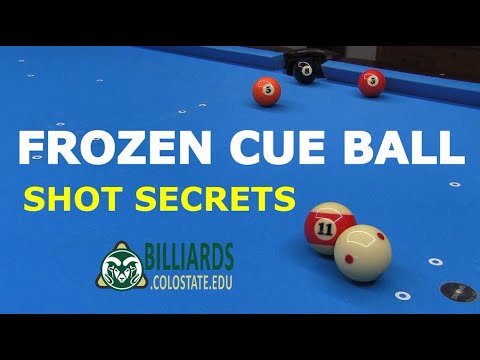
Close-contact strokes are easier to understand when viewed in slow motion. Image: Dr. Dave Billiards video thumbnail.
What makes a push shot?
A push shot is not simply a long follow-through. It occurs when the tip maintains contact with the cue ball longer than it would during a normal, legal stroke, effectively guiding or pushing the ball forward.
WPA Rule 6.8 and CSI Rule 1-29 define that prolonged contact as a foul. The judgment depends on the stroke, not merely on the fact that the cue ball began frozen to an object ball.
APA’s glossary takes a different league approach: it says push shots are not fouls. It also warns that repeatedly forcing the cue through frozen balls with a level cue and an unusually long follow-through can bring a sportsmanship penalty. In other words, APA’s treatment is not permission to guide the cue ball deliberately.
Why can the same shot receive different calls?
Imagine that the cue ball is confirmed frozen to the shooter’s legal object ball. The player aims directly through the object ball with a level cue and keeps the tip moving against the cue ball for an unusually long time.
Under WPA or CSI rules, the legal frozen-ball relationship does not erase the prolonged-contact foul. A referee can call a push shot. Under the APA Team Manual framework, the push itself is not listed as a standard ball-in-hand foul, although repeated or excessive conduct can be addressed through sportsmanship rules.
The practical lesson is simple: do not argue from memory of another league. Ask which rules are in force, then apply their definitions and procedures.
Which close-shot examples should players know?
| Table situation | Correct starting idea |
|---|---|
| Cue ball is confirmed frozen to your legal object ball | You may be able to shoot toward it, but the stroke must still comply with the governing push-shot and double-hit rules |
| Cue ball is very close but not touching | Treat it as a high-risk double-hit situation; do not use the frozen-ball exception |
| APA cue ball is frozen to an opponent’s ball or a non-lowest ball | Shoot away first, then make the required legal first contact |
| You shoot away from a frozen legal ball | The frozen ball has not been contacted by that departure; the cue ball must return to it or contact another legal ball as required |
Under WPA guidance, a very close shot that barely grazes the object ball is generally assumed not to violate the double-hit rule. That narrow example should not be converted into a blanket claim that all angled close shots are automatically legal.
How can you reduce the risk of a close-contact foul?
First, stop and establish whether the balls are touching. Ask the opponent or referee to inspect and declare the condition before getting down on the shot.
If there is a gap, choose a stroke that gives the tip room to clear. Players commonly use a cut angle, a shorter controlled follow-through, or some cue elevation. Practice these shots with a phone recording from the side, where a second contact or prolonged contact is easier to see.
Do not treat cue elevation as a magic exemption. A legal result still depends on what actually happens during the stroke. When the layout allows it, selecting a different safety or pocketing route is often smarter than testing a borderline hit.
How should a disputed shot be handled?
Call for a referee or mutually accepted observer before the shot, not after it. State which balls may be frozen and what first contact is required. A post-shot debate rarely produces reliable evidence.
If no referee is available, follow the league’s prescribed procedure rather than inventing a slow-motion standard during the match. Video can be excellent for practice, but local competition rules may not permit replay review.
The cleanest habits are procedural: identify the rule set, declare frozen balls, invite an observer for a close hit, and make the shot only after everyone understands the situation.
Is a frozen cue ball automatically a foul?
No. Frozen describes the position of the balls. Whether the shot is legal depends on the first object ball, the direction of the stroke, what the cue tip does, and the governing rules.
Is every shot toward a frozen ball a push shot?
No. WPA and CSI rules allow a player to shoot toward a frozen legal object ball with a legal stroke. A push foul requires prolonged tip-to-cue-ball contact.
Is a double hit legal in APA?
No. APA identifies a double hit as an illegal shot and includes it among ball-in-hand fouls.
Are push shots legal in APA league play?
APA’s glossary says push shots are not fouls, but repeated forceful guiding through frozen balls can be penalized as unsportsmanlike conduct. Check current local and event instructions.
Which rules do BCAPL and USAPL use?
BCA Pool League and USA Pool League use the Official Rules of CueSports International, which treat both push shots and double hits as fouls.