The 30-Shot MoFUDAT Test for Diagnosing a Crooked Pool Stroke
One striped ball and 30 recorded shots can turn a vague stroke problem into a visible, repeatable pattern.
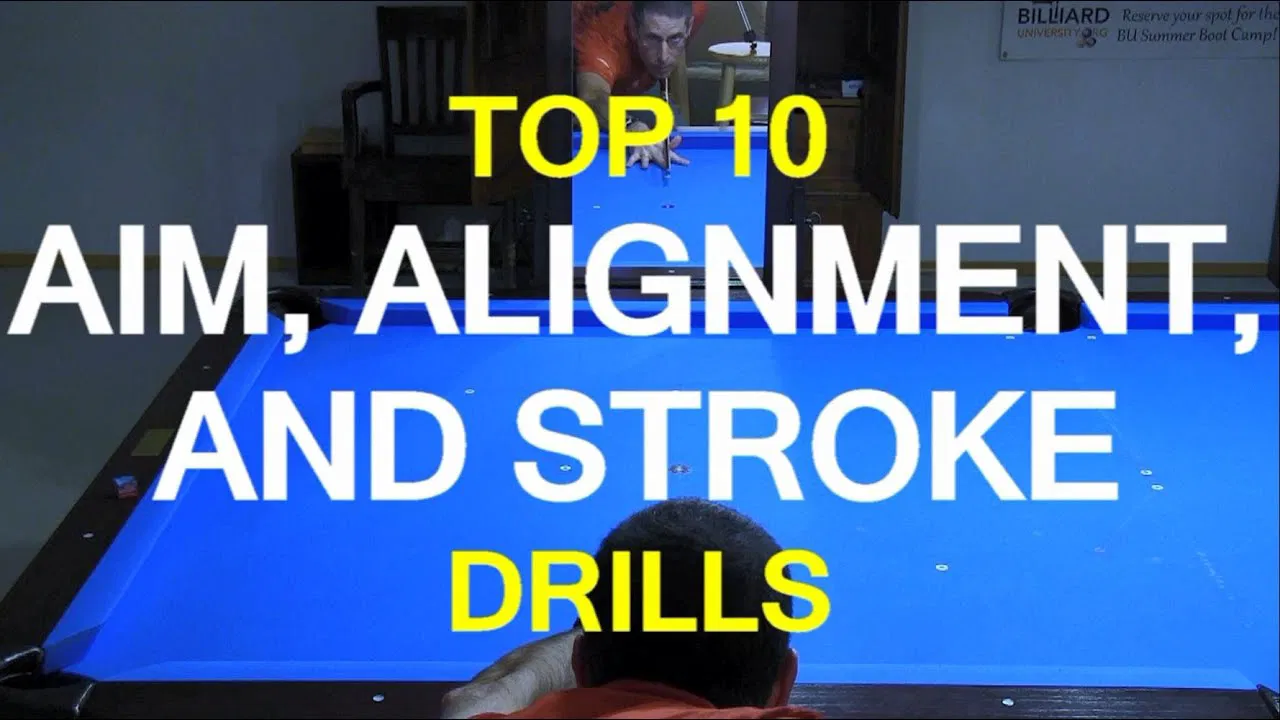
The 30-shot MoFUDAT test helps diagnose an inconsistent pool stroke by combining two visible clues: whether a striped ball wobbles and whether it returns toward the cue after rebounding from the opposite cushion. The complete test uses ten shots above center, ten at center, and ten below center.
Developed and explained by billiards instructor Dr. Dave Alciatore, the drill helps players investigate whether missed shots may be connected to aiming, alignment, unwanted sidespin, inaccurate tip placement, or inconsistent cue delivery.
Rather than relying on a vague impression that a stroke feels straight, the player collects repeatable observations that can guide technical improvement.
What Does the MoFUDAT Drill Actually Test?
The MoFUDAT drill examines several fundamental elements of cue delivery.
These include:
- Initial aiming direction.
- Body and cue alignment.
- Accuracy of cue-tip placement.
- Consistency of the forward stroke.
- Unintentional sidespin.
- Ability to repeat the same delivery.
The player sends a striped ball toward the middle of the opposite short cushion.
After rebounding, the ball should travel back toward its starting line.
Two observations are particularly important.
First, does the stripe remain visually stable as the ball moves?
Second, does the ball return close to the cue's original position?
A visibly wobbling stripe may indicate that the cue tip contacted the ball away from its intended vertical centerline.
A ball returning to one side may suggest an alignment error, unwanted spin, or a difference in cushion response.
Neither observation should be interpreted in isolation.
A ball can return close to the original line even when multiple technical errors partially cancel one another.
Why Does the Drill Use a Striped Ball Instead of a Cue Ball?
A standard white cue ball does not always make unwanted rotation easy to see.
A striped ball provides an additional visual reference.
When the stripe is aligned with the intended shot plane, its motion can reveal whether the ball is rotating cleanly around the expected axis.
What does a stable stripe indicate?
A relatively stable stripe suggests that the cue tip contacted the ball close to the intended centerline.
It does not guarantee a perfect stroke, but it is a useful indicator.
What does a wobbling stripe indicate?
A stripe that visibly oscillates from side to side may indicate unintended off-center contact.
The ball may be carrying unwanted sidespin.
This can result from incorrect cue alignment, sideways movement during the forward stroke, or inconsistent tip placement.
Can a ball return straight even with unwanted sidespin?
Yes.
The effects of alignment, spin, and cushion response can sometimes compensate for one another.
A ball that returns near the cue is not necessarily evidence of a flawless stroke.
That is why the drill combines stripe observation with ball-path analysis.
Both measurements provide useful information.
How Do You Set Up the MoFUDAT Drill?
The drill requires only a pool table, a cue, and a clearly marked striped ball.
Two additional object balls may be used to create a narrower target.
Step 1: Select a striped ball
Choose a clean, easily visible striped ball.
Avoid a heavily worn or dirty ball that may produce inconsistent movement.
Step 2: Position the ball
Place the ball on the table's longitudinal centerline, near the starting end.
Leave enough room to establish a comfortable bridge and normal shooting stance.
Step 3: Align the stripe
Rotate the ball so that the stripe is positioned in the intended vertical plane of the shot.
This makes unwanted rotation easier to observe.
Step 4: Choose the target
Aim toward the middle of the opposite short cushion.
The objective is to send the ball down the table and have it return along approximately the same line.
Step 5: Add a target gate if desired
Two object balls can be positioned near the opposite cushion to create a narrow opening.
The player attempts to send the striped ball through this gate.
Reducing the opening increases the difficulty.
Step 6: Establish a consistent stroke speed
Use a moderate, repeatable shooting speed.
Avoid striking the ball excessively hard.
Step 7: Observe the return
Pay attention to where the ball contacts the cushion and how closely it returns to the original shooting line.
The combination of stripe movement and return path forms the basis of the test.
A striped ball makes off-center contact easier to see during the up-and-down-table test. Image: Dr. Dave Billiards video thumbnail.
How Do You Perform the Full 30-Shot Test?
The complete MoFUDAT session is divided into three groups of ten shots.
Each group uses a different vertical cue-tip contact point.
The setup should remain consistent throughout the test.
Group 1: Ten Shots Above Center
The first group uses a cue-tip position slightly above the ball's center.
The intention is to produce natural forward roll while maintaining a straight stroke.
For each shot, observe:
- Whether the stripe remains stable.
- Where the ball contacts the opposite cushion.
- Whether the ball returns left or right.
- The distance between the returning ball and the original cue line.
Dr. Dave notes that above-center contact is often comparatively easy to control in this drill.
The cue can remain relatively level, and natural roll helps produce predictable ball movement.
Record the result of each shot before proceeding.
The objective is not simply to make the ball return once.
It is to repeat the same result consistently across ten attempts.
Group 2: Ten Shots at Center
For the second group, move the cue-tip contact point to the geometric center of the ball.
Keep the aiming line, stance, and intended speed as consistent as possible.
This group tests how accurately the player can identify the center of the ball and deliver the cue through that point.
A common problem is believing the cue tip is centered when it is actually positioned slightly left or right.
Even a small horizontal offset can introduce unintended sidespin.
Observe whether the stripe becomes less stable or whether the ball begins to return consistently toward one side.
Compare the results with the above-center group.
A significant difference may reveal a sensitivity to tip placement or cue delivery.
Group 3: Ten Shots Below Center
For the final group, strike the ball slightly below center.
Do not attempt to create an exaggerated draw shot.
The objective remains the same: send the ball toward the opposite cushion and observe its return.
Below-center contact can expose errors that are less obvious with natural roll.
As the ball transitions through sliding, stun, or rolling states, small amounts of unwanted sidespin may influence the rebound.
This can make the stripe's movement and the return direction more sensitive to technical inconsistencies.
Record all ten attempts.
At the end of the session, the player should have 30 observations covering three different vertical contact points.
How Can You Score Your MoFUDAT Results?
The original drill emphasizes observation and stroke diagnosis.
For players who want a numerical progress record, the following optional scoring system can be used.
Important: This is a proposed practice-tracking system, not an official Dr. Dave or Billiard University ranking scale.
Each shot receives between zero and two points.
Two points
Award two points when:
- The stripe remains relatively stable.
- The ball returns within approximately one ball diameter of the original cue position.
One point
Award one point when only one of the two main conditions is satisfied.
A return distance of approximately one to two ball diameters may also fall into this category.
Zero points
Award zero points when the stripe wobbles noticeably and the ball returns more than two ball diameters away from the intended line.
Scoring table
| Contact point | Number of shots | Maximum points |
|---|---|---|
| Above center | 10 | 20 |
| Center | 10 | 20 |
| Below center | 10 | 20 |
| Total | 30 | 60 |
The maximum score is 60 points.
However, the numerical total should not be treated as an absolute measure of playing ability.
Different tables, cushions, cloth conditions, and balls can influence the results.
The scoring system is most valuable when the same player repeats the test under similar conditions.
For example, a player who scores 35 points during the first session and 45 points under comparable conditions later has evidence of improved drill performance.
That improvement is more meaningful than comparing scores between players using different equipment.
What Do Different MoFUDAT Results Mean?
The drill can help identify patterns, but it should not be treated as a definitive diagnosis of every stroke problem.
The following table provides an initial interpretation.
| Observation | Possible cause |
|---|---|
| Stripe wobbles immediately after contact | Off-center tip placement or sideways cue movement |
| Stripe remains stable but ball misses the target | Initial aiming or alignment error |
| Ball reaches the target but consistently returns to one side | Unwanted spin, cushion response, or table conditions |
| Above-center results are strong but below-center results are poor | Increased sensitivity to tip placement or unintended sidespin |
| Results vary randomly from shot to shot | Inconsistent grip pressure, timing, movement, or stroke speed |
| Ball returns near the original line while the stripe wobbles | Different errors may be compensating for one another |
The key is to look for repeated patterns.
One bad shot provides limited information.
Ten similar errors are much more useful because they may reveal a consistent mechanical problem.
How Do You Correct an Inconsistent Pool Stroke?
The most effective approach is to identify one likely problem, make one controlled adjustment, and repeat the test.
Changing several parts of the stroke simultaneously makes it difficult to determine which modification produced the result.
Step 1: Identify the error pattern
Complete a full group of ten shots without modifying your technique.
Determine whether the misses occur consistently to one side.
A repeated directional error may indicate a systematic issue.
Random errors may suggest inconsistent timing, body movement, or cue delivery.
Step 2: Record your stroke from two angles
Video analysis can help reveal movements that are difficult to notice while shooting.
Use two camera positions.
Rear view: Position the camera behind the player's shooting line.
This view helps identify sideways cue movement and alignment problems.
Side view: Record the player's stance and arm movement from the side.
This helps reveal changes in head position, upper-body movement, and stroke timing.
Review the footage for several specific details:
- Does the cue tip return to its intended contact point after the practice strokes?
- Does the cue drift left or right during the forward stroke?
- Does the player's head or shoulder move before contact?
- Does the shooting forearm remain appropriately aligned with the cue at impact?
- Is the grip changing unnecessarily during delivery?
Dr. Dave also recommends video analysis as a practical method of investigating stroke mechanics.
Step 3: Change only one variable
Choose one adjustment at a time.
Examples include:
- Relaxing the grip.
- Modifying bridge placement.
- Adjusting head position.
- Shortening the backswing.
- Keeping the upper body stable through contact.
Repeat ten shots after making the change.
Compare the new observations with the original results.
If the stripe becomes more stable and the return path improves, the adjustment may be beneficial.
If the results become worse, reconsider the change.
Step 4: Retest all three contact points
An adjustment that improves above-center contact may not necessarily improve center-ball or below-center performance.
Therefore, repeat all three groups.
A useful technical correction should improve overall consistency without creating new problems elsewhere.
Can You Complete the Drill in a 20-Minute Practice Session?
Yes.
A structured 20-minute session can include warm-up, testing, and a short correction phase.
Minutes 1–3: Warm-up
Begin with five comfortable practice shots.
Use this period to observe how the ball rolls and how the cushions respond.
Do not record a score.
The purpose is to establish a consistent speed and become familiar with the table conditions.
Minutes 4–15: The 30-shot test
Complete all three groups:
- Ten above-center shots.
- Ten center-ball shots.
- Ten below-center shots.
Record each result immediately.
Try to avoid changing your stance or technique during the test.
The objective is to collect consistent observations.
Minutes 16–20: Targeted correction
Identify the group with the weakest results.
Review the observations or video footage.
Select one technical adjustment.
Perform five additional shots to determine whether the adjustment produces a measurable improvement.
For many players, two or three sessions per week can provide useful opportunities to track progress.
The first objective should not be achieving a perfect score.
Instead, focus on reducing variation and producing a more repeatable stroke.
How Can You Make the MoFUDAT Drill More Difficult?
Once the player achieves consistent results, the drill can be modified to create a more demanding test.
Increasing difficulty too early can make it harder to identify fundamental problems.
A practical approach is to maintain stable results across at least two sessions before introducing a new challenge.
Narrow the target gate
Place two object balls near the opposite cushion and reduce the gap between them.
This requires greater accuracy in the initial aiming line.
Reduce the acceptable return distance
Instead of allowing the ball to return within two ball diameters, require a much smaller deviation.
This increases the precision needed for a successful attempt.
Practice on a nine-foot table
A longer playing surface creates a more demanding test of alignment and directional accuracy.
Introduce scoring pressure
Complete an additional round in which every shot contributes to a recorded score.
This can help players evaluate consistency when results matter.
Require consecutive successful shots
For example, attempt five consecutive shots without receiving a zero.
If a zero occurs, restart the group.
This adds a consistency requirement rather than simply increasing the total number of repetitions.
Increasing stroke speed should not be the first method of raising difficulty.
Excessive speed can make the stripe more difficult to observe and may conceal some mechanical problems.
How Does MoFUDAT Relate to Overall Pool Skill?
A straight stroke is essential, but it is only one component of competitive pool.
Billiard University's assessment philosophy distinguishes several areas of player development, including:
- Aiming.
- Body and cue alignment.
- Stroke mechanics.
- Shot-making.
- Speed control.
- Cue-ball control.
MoFUDAT concentrates primarily on accurate and repeatable cue delivery.
It does not directly measure advanced position play, tactical knowledge, or the ability to run an entire rack.
A player with an excellent MoFUDAT result may still struggle with cut shots, safety play, kick shots, break technique, or cue-ball positioning.
Similarly, an experienced player may achieve good match results while retaining small mechanical inconsistencies.
The drill is therefore best understood as a diagnostic training tool rather than a complete playing-ability examination.
It can complement broader systems such as the Billiard University exams, but it does not replace them.
What Are the Most Common Mistakes During MoFUDAT Practice?
Several habits reduce the value of the test.
Using a plain white cue ball
Without a visible stripe, unintentional rotation becomes harder to identify.
Failing to align the stripe before each shot
Inconsistent stripe orientation makes comparisons less reliable.
Shooting too hard
Excessive speed can complicate observations and increase variation.
Changing stroke speed
Different speeds may produce different rebound characteristics.
Moving the body too early
Premature head or shoulder movement can affect cue delivery.
Ignoring stripe movement
A ball returning near the original line does not necessarily indicate clean centerline contact.
Making several corrections at once
Changing grip, stance, bridge, and alignment simultaneously prevents meaningful diagnosis.
Drawing conclusions from one shot
A single attempt cannot establish a reliable pattern.
Ignoring table conditions
Cushions, cloth, dirt, and table level can influence ball movement.
Treating the drill as proof of one specific mechanical fault
The same visible result may have several possible causes.
For meaningful improvement, the player should collect repeated observations before making a technical correction.
Could the Table Be Causing the Ball to Drift?
Yes.
A ball that fails to return along the expected line is not always evidence of a crooked stroke.
Several external factors may affect the result.
These include:
- A table that is not perfectly level.
- Uneven cushion response.
- Dirty or worn balls.
- Inaccurate contact with the opposite cushion.
- Differences in ball speed.
- Imperfect stripe symmetry.
- Unintended changes in the player's aiming point.
One useful diagnostic method is to repeat the drill from the opposite end of the table.
If the direction of the error changes when the drill is reversed, table conditions may be contributing.
This does not automatically prove that the stroke is correct.
It simply helps separate equipment-related effects from possible player-related errors.
The goal is to avoid unnecessary technical changes based on misleading observations.
Who Should Practice the MoFUDAT Drill?
The drill can benefit several types of players.
Beginners
New players can use it to develop awareness of centerline contact and a straight cue delivery.
Intermediate players
Players who frequently miss relatively straight shots can use it to identify recurring errors.
League competitors
A consistent stroke is valuable under pressure, making the drill useful as part of regular league preparation.
Players struggling with draw shots
Below-center contact can expose unwanted sidespin and inconsistent tip placement.
Advanced players
Experienced players can use the drill as a periodic fundamentals check.
Pool instructors
Coaches can combine MoFUDAT observations with video analysis and written performance records.
The ability to repeat the same test makes it useful for monitoring changes over time.
What Is the Best Way to Track Long-Term Improvement?
The most useful training record includes more than a single total score.
After each session, record:
- The date and table used.
- The score for each ten-shot group.
- The direction of the most common errors.
- The amount of visible stripe wobble.
- The technical adjustment being tested.
- Whether performance improved after the adjustment.
Over several sessions, patterns may emerge.
For example, a player might consistently perform well with above-center contact but produce unwanted sidespin below center.
Another player might generate stable rotation while repeatedly missing the target to the same side.
Those two players may require different corrections.
A structured record helps prevent them from applying identical solutions to different problems.
Can MoFUDAT Help You Build a Straighter Stroke?
Yes. MoFUDAT provides a repeatable method of observing several important aspects of cue delivery.
Its greatest value is not the number of balls successfully returned to the starting position.
It is the ability to answer specific questions:
- Is the stripe wobbling?
- Where does the ball contact the cushion?
- Does the ball consistently return left or right?
- Are the errors repeated or random?
- Which cue-tip contact point produces the greatest difficulty?
- Does a controlled technical adjustment improve the result?
These observations make practice more productive.
Instead of making broad changes based on an occasional missed shot, the player can collect evidence, identify patterns, and test one correction at a time.
A dependable pool stroke is developed through consistent repetition, careful observation, and measurable feedback.
MoFUDAT offers a straightforward way to bring those elements together.
Why are there exactly 30 shots in the test?
The test uses ten above-center, ten center-ball, and ten below-center attempts. Comparing the three groups shows whether vertical tip position changes the player's consistency.
Does a ball returning to the cue prove a perfect stroke?
No. Cushion response, table roll, setup, and compensating errors can influence the return. Stripe stability and repeated left-right patterns must also be considered.
Is the 60-point system an official MoFUDAT rating?
No. It is an optional practice-tracking system proposed in this guide. It is not an official Dr. Dave or Billiard University ranking or certification scale.
Why might below-center shots produce weaker results?
Low contact can make unintended sidespin and tip-placement errors more visible after the rebound. The result is a diagnostic clue, not proof of one specific fault.
Should a player change technique after every bad shot?
No. Complete a group of shots, identify a repeated pattern, and then test one controlled adjustment at a time.
Sources and Further Reading
Dr. Dave – Original Drill and Technical Guidance
- MoFUDAT Center-Ball Stroke Drill
- Fundamentals Part I: MoFUDAT
- MoFUDAT One-Page Drill Sheet
- Stroke Drills
- Stroke Technique Advice