Does Expensive Pool Chalk Give You More Spin?
Price can change cleanliness and convenience, but it does not override the miscue limit. Here is what actually matters—and a 12-shot test to diagnose problems.
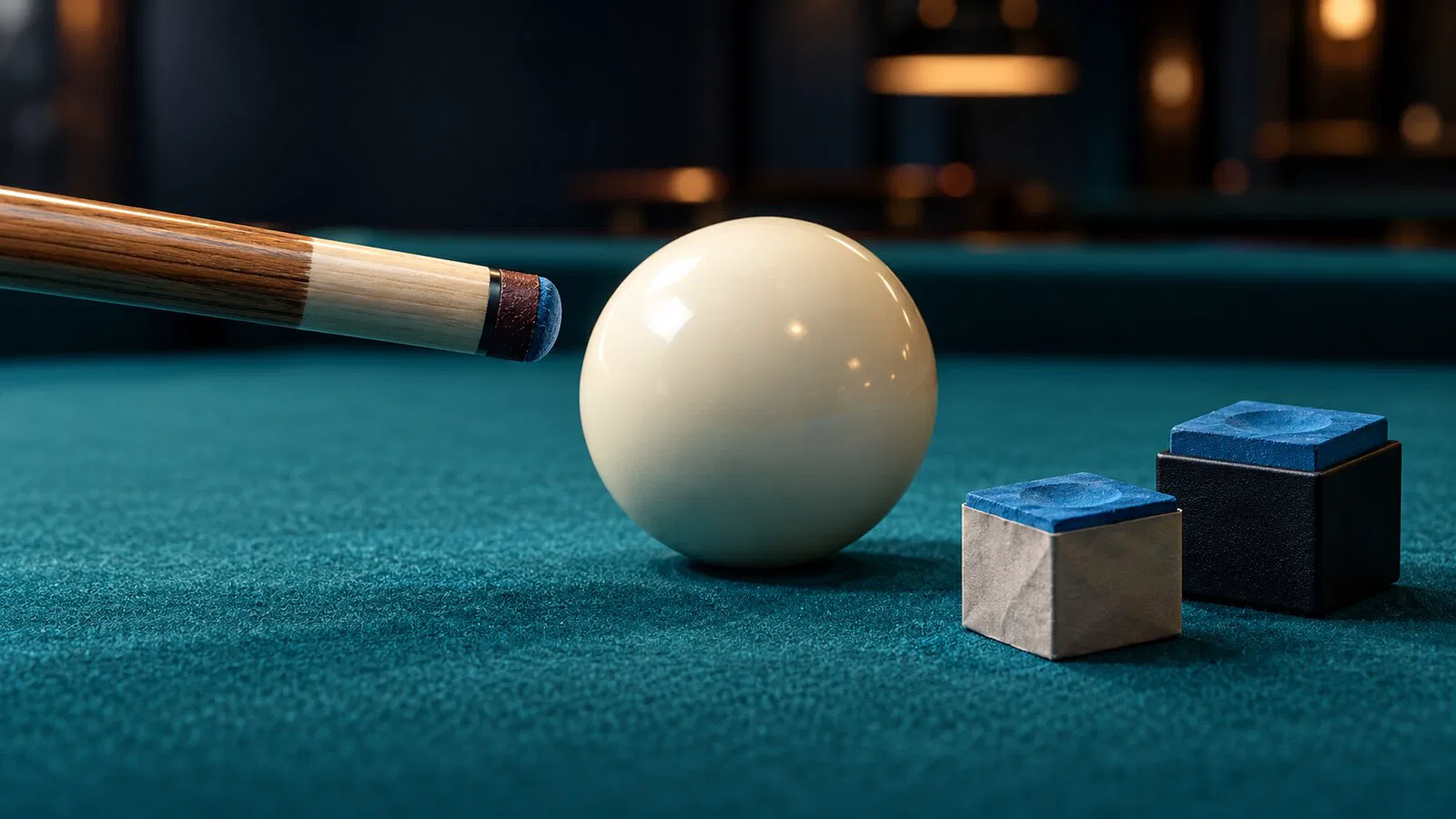
No. Expensive pool chalk does not automatically create more cue-ball spin. Once a properly maintained leather tip has enough evenly applied chalk to grip the ball, usable spin depends mainly on where the tip strikes, cue speed, stroke accuracy, and whether the contact stays inside the practical miscue limit.
Premium chalk can still be worth buying. Some formulas remain on the tip longer, shed less dust, transfer less residue to the cue ball, or feel easier to apply. Those are real differences in convenience and cleanliness—but they are not proof of extra maximum spin.
What Does Pool Chalk Actually Do?
Pool chalk increases the grip between the cue tip and the curved surface of the cue ball during impact. This matters most on off-center hits used to produce draw, follow, or sidespin.
Without enough grip, the tip can slide away from the intended contact point. The result is a miscue: usually a sharp sound, an unreliable cue-ball path, and a visible mark where the tip slipped.
Chalk therefore performs one essential job: it makes normal off-center contact dependable. It does not remove the geometric limit on how far from center a player can strike.
Does Premium Chalk Produce More Spin?
Not simply because it costs more. In chalk comparisons summarized by billiards instructor and researcher Dr. Dave Alciatore, the tested products showed no measurable difference in their maximum-spin miscue limit when the cue tip was chalked correctly.
The useful distinction is between maximum performance and day-to-day usability. Different products may behave differently between shots even when their peak miscue limits are similar.
| Chalk Characteristic | Practical Benefit | What It Does Not Guarantee |
|---|---|---|
| Stays on the tip longer | Fewer applications may be needed | More maximum spin |
| Produces less dust | Cleaner hands, shaft, and cloth | Better stroke mechanics |
| Transfers less to the cue ball | Less frequent ball cleaning | A wider safe contact zone |
| Applies smoothly | Easier, more even coverage | Freedom to strike anywhere on the ball |
| Costs more | May reflect formula, holder, or packaging | Better results for every player |
If a modestly priced chalk coats the full tip and supplies reliable grip, a more expensive cube cannot automatically make the same hit spin more. A premium option may still be a sensible purchase for a home-table owner who values cleanliness or a player who prefers longer retention.
What Actually Determines Cue-Ball Spin?
Five variables matter far more than the price of the chalk:
- Tip position. Moving the contact point away from center increases the spin-to-speed ratio until the practical miscue boundary is approached.
- Cue speed. More speed can produce more cue-ball speed and rotation, but only when the player still delivers the tip accurately.
- Quality of contact. The tip must be chalked, shaped, and capable of holding the chalk.
- Stroke direction. Unwanted sideways movement changes the actual contact point and can push it beyond the safe zone.
- Shot choice. Sometimes using a little less tip offset and adjusting speed, angle, or position route is more reliable than demanding maximum spin.
The curved ball surface becomes increasingly steep as contact moves away from center. Near the miscue limit, the tip is more likely to be pushed away from the ball. Extra friction cannot expand that safe zone without limit.
Does a Soft Cue Tip Create More Spin Than a Hard Tip?
Not within the normal range of playing-cue tips, assuming both tips are maintained, chalked, and strike the same point at the same cue-ball speed.
A soft tip often feels quieter and may hold chalk more easily. It can also mushroom or change shape sooner. A hard tip usually feels firmer and tends to hold its shape longer. These differences affect feel and maintenance more than maximum spin.
| Tip Property | Softer Tip | Harder Tip |
|---|---|---|
| Impact feel | Softer, more muted | Firmer, sharper |
| Chalk retention | Often easier | Needs attention if the surface glazes |
| Shape over time | May mushroom or flatten sooner | Usually remains stable longer |
| Maintenance | May need shaping more often | Often needs less frequent shaping |
| Maximum spin when maintained | Comparable | Comparable |
Choose tip hardness for feedback, durability, and maintenance preference—not because a soft tip is expected to fix an inaccurate stroke.
How Should You Chalk a Cue Tip Correctly?
The goal is a thin, even coating across the complete curved playing surface, especially near the edge used for spin shots.
- Hold the tip under good light and look for bare, shiny, or glazed areas.
- Hold the chalk at a slight angle instead of pressing it squarely onto the tip.
- Brush lightly from one side of the dome to the other.
- Rotate the cue slowly and repeat until the full circumference is covered.
- Inspect the surface again. Add chalk only where leather remains visible.
- Remove loose excess gently; do not strike the chalk against the rail.
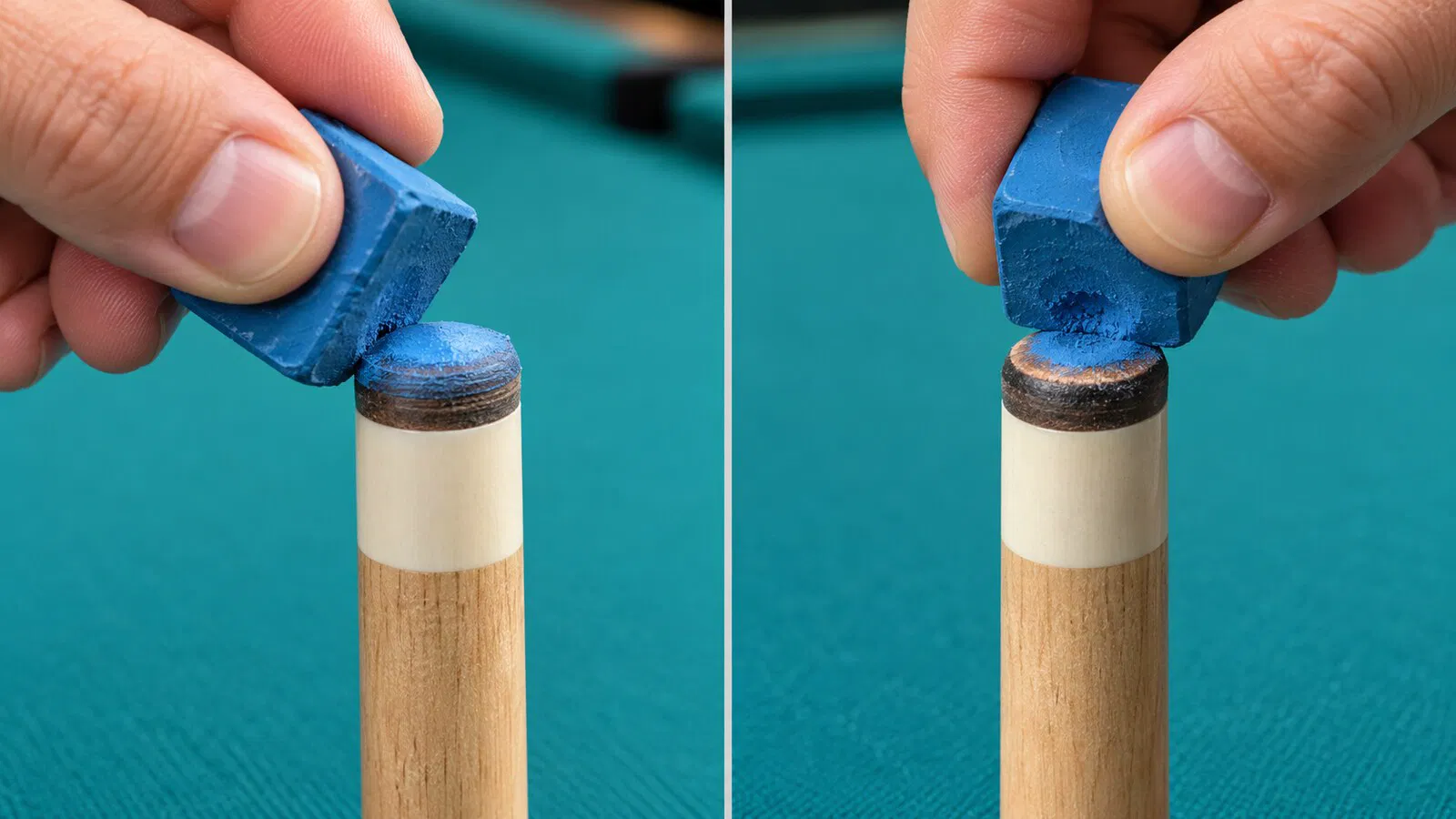
Left: light brushing coats the dome to the edge. Right: drilling into the center can leave an unreliable bare ring. Original image created for Billiard News.
The common “drilling” motion—pushing the cube straight down and twisting—can hollow out the chalk while concentrating material in the center. It may leave the tip edge unevenly coated and can also mark the ferrule.
Chalking before every shot is a useful routine because it combines inspection with preparation. A long-lasting formula may not require a complete reapplication each time, but the tip should always be checked before a demanding draw, follow, or English shot.
What Causes a Miscue Even After Chalking?
A miscue is not automatically evidence of bad chalk. Diagnose the cause in a consistent order.
Is the tip covered evenly?
Look for exposed leather or a shiny ring near the edge. Reapply chalk with light brushing if coverage is incomplete.
Was the contact point too far from center?
Players often address the cue ball at one offset and strike farther out because the cue drifts during delivery. Reduce the offset and confirm the actual chalk mark on the ball.
Did the cue travel straight?
A last-second steering motion can place the tip beyond the intended point. Check alignment, bridge stability, grip pressure, and whether the cue finishes on the same line it started.
Is the tip glazed, flat, or damaged?
A polished surface may not retain chalk. A badly flattened, cracked, delaminated, loose, or very low tip needs maintenance or replacement.
Are the contact surfaces clean?
Oil, moisture, old chalk, and other residue can affect contact and increase unwanted throw between balls. Clean equipment only with methods approved by the table operator or manufacturer.
When Should You Scuff, Reshape, or Replace a Cue Tip?
Scuff only when the leather surface has become glazed or refuses to accept chalk. Use a suitable tip tool gently. Removing leather after every session shortens tip life without improving a healthy surface.
Reshape the tip when the dome has become too flat or irregular to present a consistent playing surface. Work gradually and preserve enough leather above the ferrule.
Replace the tip when:
- It remains unable to hold chalk after careful surface maintenance.
- The leather is cracked, severely damaged, or too low.
- Layers are separating on a laminated tip.
- The tip or glue bond is loose.
- A safe, consistent dome can no longer be restored.
Never continue using a tip so low that the ferrule risks striking the cue ball.
How Can You Run the 12-Shot Chalk and Stroke Test?
This ten-minute drill is designed to reveal a pattern in miscues. It is not a laboratory comparison of chalk brands, and its purpose is not to force extreme contact.
Set up the same medium-distance straight shot for all 12 attempts. Use one cue ball, one playing cue, one speed range, and one aiming line. Clean the cue ball first, inspect the tip, and chalk correctly before every shot.
| Group | Shots | Cue-Ball Contact | Diagnostic Goal |
|---|---|---|---|
| 1 | 4 | Center ball | Establish basic delivery accuracy |
| 2 | 4 | About one tip left of center | Test left-English consistency |
| 3 | 4 | About one tip right of center | Test right-English consistency |
“One tip” is only a visual reference. Keep every hit inside a comfortable, safe offset for your equipment and skill level.
After each shot, record:
- Whether a miscue occurred.
- Whether the cue ball started on the intended line.
- Whether the tip remained evenly coated.
- Where the fresh chalk mark appeared on the cue ball.
- Whether the cue felt as if it moved sideways through impact.
How should you interpret the pattern?
- Center hits fail: inspect the tip, chalk coverage, and fundamental delivery before adding spin.
- Only left English fails: alignment or stroke delivery may be different on the left side.
- Only right English fails: check for the opposite directional bias.
- Both English groups fail: reduce the offset and inspect tip shape and chalk retention.
- No miscues but poor starting lines: the larger problem is stroke accuracy, not friction.
Repeat the test after changing only one variable. For example, correct the chalking motion first, then repeat. If you change chalk, tip shape, stance, and speed together, the result cannot identify which adjustment mattered.
What Do WPA Rules Say About Chalk?
The WPA Rules of Play effective September 15, 2025 state that a player may apply chalk to prevent miscues and may use personal chalk when its color is compatible with the cloth. The same rule says chalk cannot be used as a marker for aiming or alignment.
Practical tournament habits follow from that wording:
- Match the chalk color to the cloth or ask tournament staff before play.
- Do not position a chalk cube as an aiming reference.
- Keep chalk away from any place where a moving ball could contact it.
- Follow event-specific equipment instructions when they differ or add restrictions.
League and local tournament procedures can vary, so always check the rules announced for the event you are actually playing.
Is Premium Pool Chalk Worth the Money?
It can be—but buy it for the benefit you can actually observe.
Premium chalk may be worthwhile if you want less dust around a home table, less residue on the cue ball, a smoother application, or longer retention between shots. A player who prefers to chalk before every attempt may place less value on retention and more on cleanliness or feel.
Do not expect price alone to correct a glazed tip, a crooked stroke, or an extreme contact point. Before changing products, inspect the tip, improve the coating, and run the 12-shot test. Those steps often reveal a more useful fix.
Frequently Asked Questions
Does expensive pool chalk help you draw the cue ball farther?
Not by itself. Draw depends on striking below center accurately, delivering appropriate speed, and preserving backspin until contact with the object ball. If ordinary chalk already supplies reliable grip, a higher price does not guarantee more draw.
Can you put spin on the cue ball without chalk?
Very small off-center hits may be possible under some conditions, but the miscue risk rises sharply. Chalk is essential for dependable draw, follow, and sidespin in normal play.
Should you chalk before every shot?
It is a useful and consistent habit, especially with standard chalk or before a spin shot. A formula that stays on longer may not need a full reapplication, but inspection should remain part of the routine.
Does a soft tip need more chalk than a hard tip?
There is no universal rule. Chalk retention depends on the tip material, surface condition, shape, formula, and application method—not hardness alone.
Why do I miscue when the tip looks blue?
Color in the center is not enough. The intended contact area near the edge may still be bare, the surface may be glazed, the actual hit may be too far from center, or the stroke may move sideways.
Can chalk color matter in a tournament?
Yes. Under current WPA rules, personal chalk must have a color compatible with the cloth. Event officials can clarify what is accepted on a specific table.
What Is the Bottom Line?
Good pool chalk is chalk that covers the tip evenly, supplies reliable grip, fits the table rules, and supports a repeatable routine. Premium products can deliver cleaner use or longer retention, but they do not create extra spin simply because they cost more.
For more consistent cue-ball control, prioritize the basics: maintain the tip, coat the full dome, strike within the safe zone, deliver the cue straight, and keep the equipment clean. Technique and contact quality remain the biggest performance gains available.