Pool Break Technique: Improve Control Before Adding Power
A productive break is the fastest one you can deliver while keeping accurate rack contact, a legal spread, and reliable cue-ball control.
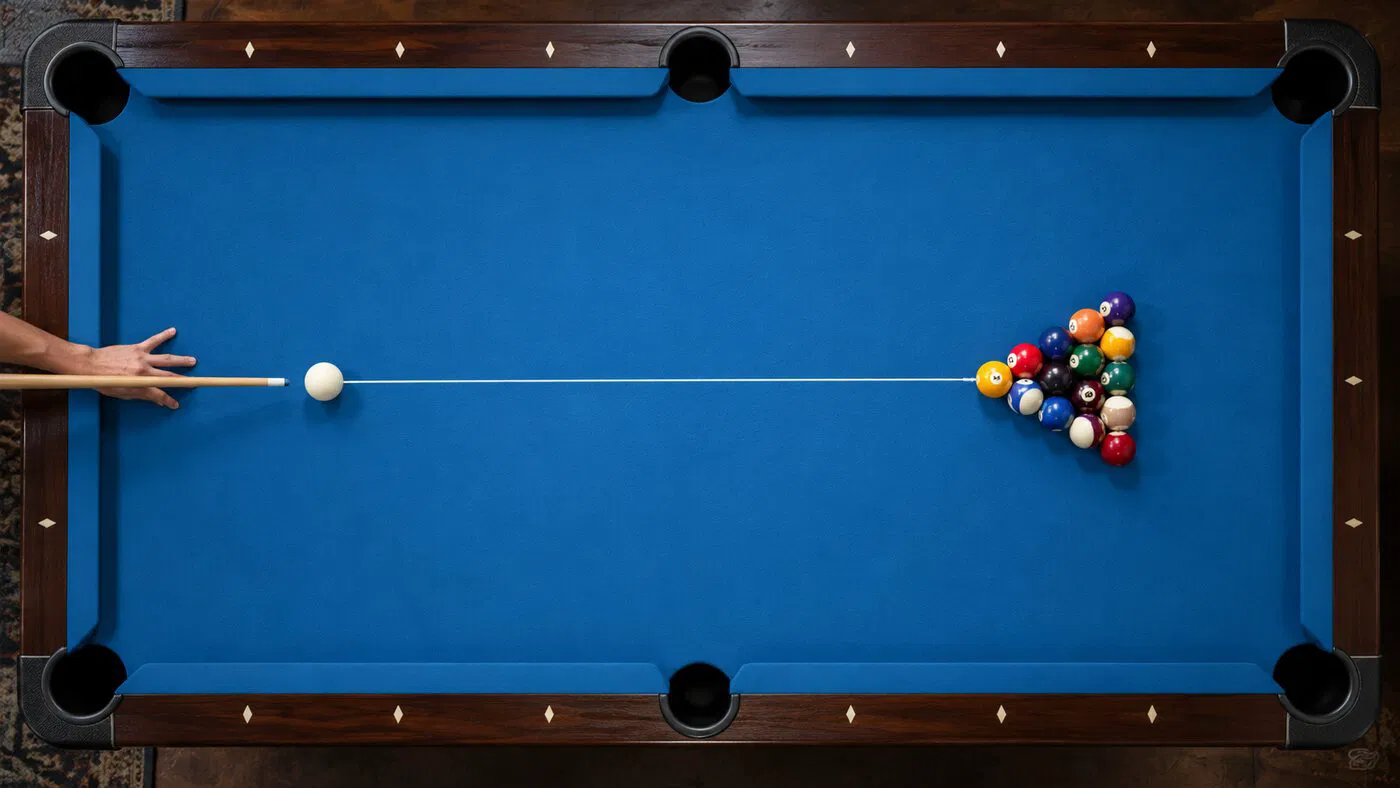
Why More Power Does Not Always Produce a Better Break
The best pool break is the fastest one you can deliver while still making accurate rack contact and controlling the cue ball. Additional power stops helping when it creates off-center contact, scratches, or unpredictable cue-ball movement.
A powerful break can look impressive, but dramatic ball spread or cue-ball hop does not automatically prove that the break was effective.
Players need to deliver energy efficiently into the rack, maintain control of the cue ball, and comply with the rules of the game.
If a player consistently generates maximum power but frequently scratches or loses control of the cue ball, that extra speed may offer little competitive advantage.
Instructional guidance from Dr. Dave Alciatore emphasizes that an accurate, square hit on the head ball is more important than excessive power.
The practical objective is to find the highest break speed a player can execute consistently without sacrificing accuracy.
Why Is a Square Hit More Important Than Maximum Speed?
During a break shot, the cue ball transfers energy into the rack through its collision with the front ball.
When the cue ball strikes the head ball nearly squarely, energy transfer into the rack is generally more efficient.
The cue ball is also more likely to remain near the center portion of the table when the stroke, contact point, and spin are properly controlled.
An off-center collision creates different results.
Some of the cue ball's momentum continues sideways rather than transferring directly through the rack.
This can produce excessive cue-ball movement and increase the risk of scratching.
It also makes the break less predictable.
A player might hit the cue ball extremely hard but still produce poor ball separation if contact with the rack is inaccurate.
The Practical Lesson
Before increasing power, establish the ability to repeatedly strike the intended point on the head ball.
A slightly slower square hit can be more productive than a faster collision that consistently misses the desired contact point.
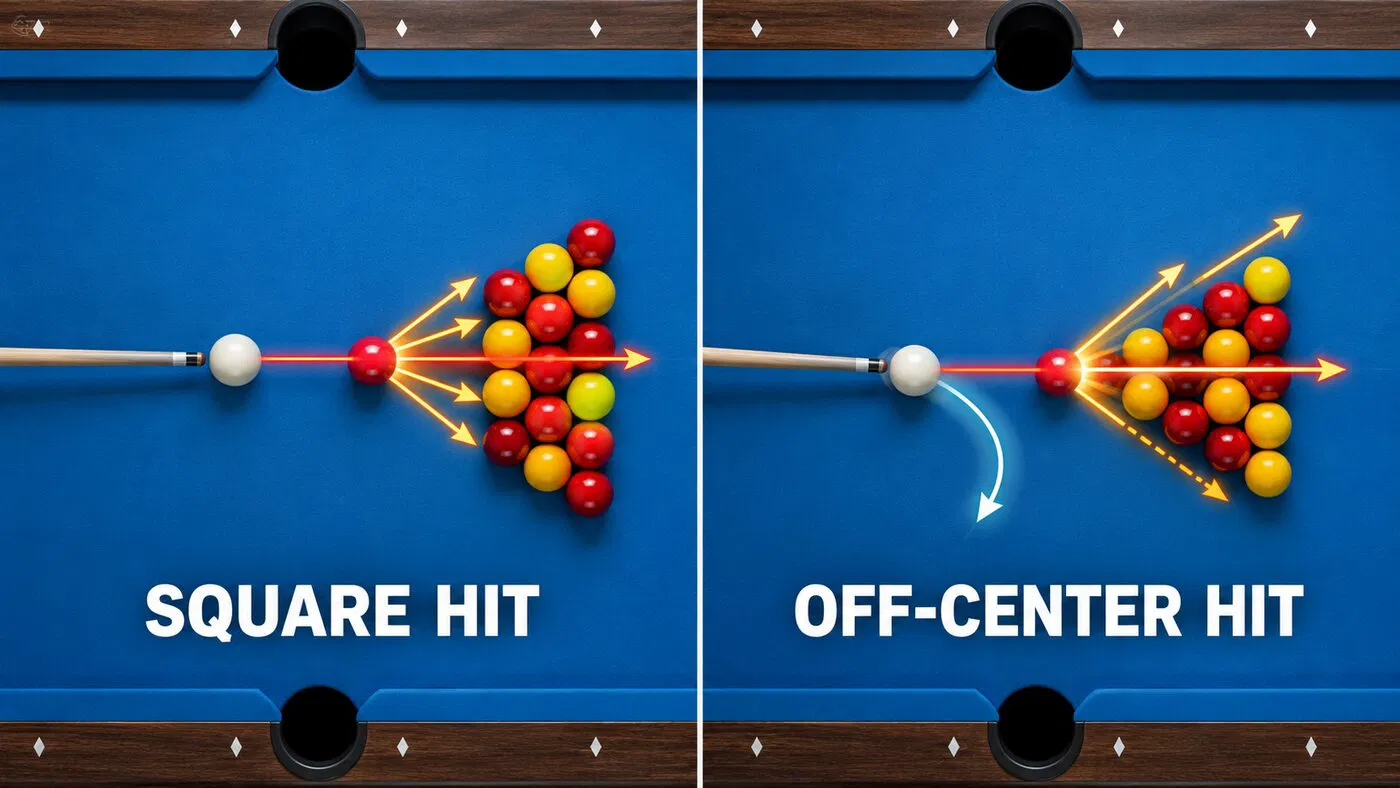
A square hit sends energy more directly through the rack; an off-center hit redirects part of the cue ball's momentum. Original illustration created for Billiard News.
How Should You Prepare for a Controlled Break?
Start With a Tight Rack
The condition of the rack has a significant effect on break results.
Small gaps between neighboring balls can change how energy travels through the triangle.
Consequently, two technically similar break shots may produce noticeably different layouts if the balls were not racked consistently.
For WPA 8-ball, the 15 object balls must be arranged as tightly as possible.
The apex ball is positioned on the foot spot, with the 8-ball placed directly below the apex ball in the specified position.
One ball from each group occupies the two lower corners of the rack.
These requirements are defined in Section 4.2 of the WPA Rules of Play.
Aim Through the Center of the Head Ball
During early practice, begin from a position near the middle of the head string.
This provides a simple reference line for evaluating the break.
Align the cue ball toward the intended contact point on the front ball.
Your immediate objective should not be pocketing a specific number of balls.
Instead, concentrate on making the same accurate contact repeatedly.
Once the break becomes consistent, experiment with different starting positions.
Establish a Stable Bridge
Break shots typically require a longer cue acceleration path than ordinary shots.
A somewhat longer bridge can help accommodate that movement.
However, increasing bridge length is only useful if the bridge remains stable.
If the bridge hand moves, lifts, or slides before cue-ball contact, the player may lose the alignment established during the aiming process.
A reliable bridge should support a smooth acceleration without restricting the cue.
Keep the Grip Relaxed
Excessive grip pressure can interfere with cue delivery.
When the player tightens the hand and arm too early, unnecessary muscular tension may reduce stroke fluidity.
A relaxed grip allows the cue to accelerate naturally.
The grip should remain secure enough to control the cue, but not so tight that it forces unwanted movement.
Keep the Cue as Level as Practical
A break cue generally cannot remain perfectly horizontal because the rail creates clearance requirements.
Some cue elevation is therefore unavoidable.
However, deliberately increasing the cue angle can create additional problems.
A steeply elevated cue drives more force downward into the cue ball.
That increases the likelihood of bouncing and may reduce the amount of useful energy delivered to the rack.
It can also make an off-center hit less predictable.
Dr. Dave explains that the slight hop often seen in powerful breaks is a consequence of cue elevation and contact dynamics, not a movement players should intentionally exaggerate.
How Can You Keep the Cue Ball Near the Center of the Table?
One desirable outcome of a controlled break is for the cue ball to remain near the middle of the table after striking the rack.
Pool players commonly refer to this result as making the cue ball squat.
To produce this reaction, the cue ball generally needs a small amount of forward rotation.
Because the clustered rack behaves like a relatively large effective mass during the collision, the cue ball may rebound backward after impact.
A slight amount of topspin can counteract that backward movement.
The adjustment should be small.
Contacting the cue ball only slightly above center may be sufficient for a strong, square break.
Hitting too far above center can cause the cue ball to travel forward excessively after impact.
Likewise, an inaccurate collision can produce sideways movement even when the player applies the intended spin.
Three Common Cue-Ball Reactions
| Cue-Ball Reaction | Possible Explanation | Practice Adjustment |
|---|---|---|
| Rebounds backward | Insufficient forward rotation or the collision dynamics produce substantial rebound | Check square contact and consider a slightly higher tip position |
| Stops near table center | Suitable combination of contact accuracy, spin, and speed | Repeat the same setup |
| Continues toward the far end | Excessive forward rotation or an unsuitable contact/speed combination | Reduce topspin and reassess contact |
These observations are diagnostic guidelines, not absolute rules.
Ball cleanliness, cloth conditions, cue elevation, and rack tightness can also influence the final position.
How Do You Find Your Maximum Accurate Speed?
The first exercise is designed to identify how quickly a player can deliver the cue while maintaining a straight shot.
It uses a long stop shot rather than a full rack.
The concept is consistent with the break practice method described in Dr. Dave's instructional resources.
Equipment and Setup
Use a standard pool table, cue ball, and one object ball.
Place the cue ball near the head string.
Position the object ball on the foot string, aligned with a corner pocket.
The two balls should form a straight shooting line toward the pocket.
Training Procedure
Step 1: Begin at a moderate speed.
Step 2: Pocket the object ball while attempting to stop the cue ball near the point of collision.
Step 3: Repeat until you can execute the shot consistently.
Step 4: Increase speed slightly.
Step 5: If the object ball misses the pocket or the cue ball travels too far after contact, reduce the speed.
Step 6: Increase power again only after completing at least three successful attempts in succession.
Continue gradually until you identify the highest speed that still produces reliable pocketing and cue-ball control.
Why Does This Drill Work?
The exercise separates stroke accuracy from the complicated ball interactions that occur during a full break.
Instead of evaluating a scattered rack, players can observe two clear outcomes:
Whether the object ball enters the pocket and whether the cue ball stops near the intended position.
The objective is to develop a reliable upper limit for controlled stroke speed.
That speed provides a useful starting reference for break practice.
How Does the 18-Break Power-Control Challenge Work?
Once the player has established a controlled stroke, the next step is to determine which break intensity produces the most reliable results.
This exercise uses 18 full-rack 8-ball breaks.
It is an editorial practice drill, not an official WPA scoring examination.
Divide the Breaks Into Three Groups
| Group | Power Level | Number of Breaks |
|---|---|---|
| A | Moderate power | 6 |
| B | Strong but controlled | 6 |
| C | Highest power the player believes is manageable | 6 |
| Total | 18 |
Use the same cue-ball starting position for all 18 attempts.
Keep the rack setup and equipment as consistent as possible.
Avoid changing several technical variables at once.
Score Each Break
Award a maximum of three training points for each break.
| Condition | Points |
|---|---|
| Cue ball stays on the playing surface without scratching | 1 |
| Cue ball finishes within approximately one diamond of table center | 1 |
| Break satisfies the rules being practiced | 1 |
| Maximum | 3 |
The first two criteria evaluate cue-ball control.
The third evaluates whether the break meets the applicable rules.
For example, under WPA 8-ball rules, if no object ball is pocketed, at least four object balls must reach one or more cushions.
Failing this requirement results in an illegal break.
This scoring exercise must not be confused with an official tournament scoring system.
Players competing in APA, CSI, or other leagues should check the requirements applicable to their events rather than automatically applying WPA rules.
Record Additional Observations
Besides the numerical score, record the final position of the cue ball.
Also note whether the head ball was struck squarely or slightly off-center.
Finally, record whether any object balls were pocketed.
These observations help explain why a particular power level performs better or worse.
How Do You Select the Best Break Speed?
After completing the 18 shots, compare the three groups.
The goal is not to identify the single most spectacular break.
Instead, look for the most dependable combination of accuracy, legal execution, and cue-ball positioning.
Example Practice Results
Consider a player who records the following hypothetical results:
| Power Level | Average Score | Scratches | Cue Ball Near Center |
|---|---|---|---|
| Moderate | 2.5/3 | 0/6 | 5/6 |
| Strong but controlled | 2.7/3 | 0/6 | 5/6 |
| Maximum | 1.8/3 | 2/6 | 2/6 |
Average scores are rounded to one decimal place.
Although the maximum-power group may produce the most dramatic individual break, it also creates more cue-ball control problems.
The strong-but-controlled group performs better overall.
It achieves the highest average score without producing scratches in this example.
For that player, the middle power level would be the most reasonable starting choice for competitive play.
Why Consistency Matters
A break should help create a playable table.
If maximum power frequently sends the cue ball into a pocket or leaves it near a difficult rail position, the additional speed may reduce its practical value.
The more useful strategy is to select a power level that can be repeated accurately.
Players can then increase speed gradually as their technique improves.
What Are the Most Common Break Shot Mistakes?
Increasing Power Before Accuracy
Many developing players attempt to hit the rack harder before they can consistently make square contact.
This usually makes their results more unpredictable.
Accuracy should improve before power is increased.
Trying to Make the Cue Ball Jump
A jumping cue ball may look impressive, but excessive elevation can waste energy and reduce accuracy.
Players should not deliberately increase cue elevation simply to create a dramatic break.
Gripping the Cue Too Tightly
Unnecessary muscular tension may interrupt the natural acceleration of the cue.
A relaxed but controlled grip generally provides a better foundation.
Moving the Bridge Before Impact
A stable bridge is essential for maintaining the intended cue direction.
Premature movement can introduce unintended sidespin or change the impact point.
Ignoring Cue-Ball Position
Pocketing several balls is useful only when the remaining position allows the player to continue effectively.
Break practice should evaluate both ball distribution and cue-ball control.
Practicing With Inconsistent Racks
A loose rack can produce misleading results.
Before blaming stroke mechanics, confirm that the balls are arranged consistently.
Changing Too Many Variables
Changing break position, speed, tip placement, and body movement simultaneously makes it difficult to identify which adjustment caused an improvement.
A structured practice session should isolate individual variables whenever possible.
How Does Billiard University Approach Break Training?
Billiard University treats the break as a distinct skill rather than simply a powerful opening stroke.
Within its Exam II framework, the break is identified as Skill S10.
Other evaluated skills include aiming, position control, safety play, kick shots, and bank shots.
This structure reinforces an important training principle.
Break performance can be developed through targeted exercises, observation, and repeatable assessment.
The 18-break challenge described above follows that general philosophy by encouraging players to measure outcomes rather than relying only on subjective impressions.
How Should Different Skill Levels Practice?
Beginners
Start with the long stop-shot exercise.
Use moderate power and prioritize straight cue delivery.
Avoid trying to copy the maximum-speed breaks of professional players.
Intermediate Players
Introduce the 18-break challenge.
Track the cue ball's final location and compare different power levels.
Practice maintaining the same setup throughout each group.
Advanced Players
Experiment with additional variables after establishing a reliable baseline.
These may include:
- Cue-ball starting position.
- Slight variations in tip contact height.
- Break-cue characteristics.
- Rack template differences.
- Table and cloth conditions.
Change one variable at a time so that the effect can be evaluated.
Is a harder break always better in 8-ball?
No. A harder break can increase ball separation, but only if the player maintains effective contact and cue-ball control. Excessive speed can increase inconsistency.
Where should the cue ball be positioned for a beginner's break?
Beginning near the center of the head string provides a straightforward reference for practicing square contact. More advanced players can experiment with different positions once their technique becomes consistent.
Why does the cue ball jump during a powerful break?
The cue often contacts the cue ball at a slight downward angle because it must clear the rail. This can cause the cue ball to bounce as it travels toward or collides with the rack.
Should I use topspin when breaking?
A small amount of topspin can help the cue ball settle near the middle of the table after striking the rack. Excessive topspin can create unwanted forward movement.
How many breaks should I practice?
The 18-break exercise provides a manageable session for comparing three power levels. Players can repeat the exercise periodically to monitor progress.
Does the same break technique work in every league?
The fundamentals of accuracy and cue-ball control remain relevant, but legal-break requirements may differ between governing bodies and competitions. Always consult the applicable rules.
What Is the Final Takeaway?
A successful break is not determined by maximum cue speed alone.
The most productive break combines accurate contact, efficient energy transfer, a stable stroke, and predictable cue-ball behavior.
Players should establish a consistent foundation before attempting to increase power.
The long stop-shot exercise helps identify a reliable stroke speed, while the 18-break challenge provides a practical method for evaluating performance under different power levels.
Together, these exercises offer a structured approach to improving the break.
Ultimately, a good break should do more than scatter the balls.
It should leave the player with a controlled cue ball and a realistic opportunity to continue the game.
Sources
Official rules
World Pool Association — Rules of Play, Effective September 15, 2025
Expert instructional sources
Dr. Dave — Break Technique Advice
Dr. Dave — Cue Ball Hop and Squat on the Break
Educational source