Pool Chalk, Cue Tips, and Miscues: Does Price Add Spin?
Premium chalk may improve retention, cleanliness, or convenience, but proper application and a maintained tip matter more than price for usable spin.
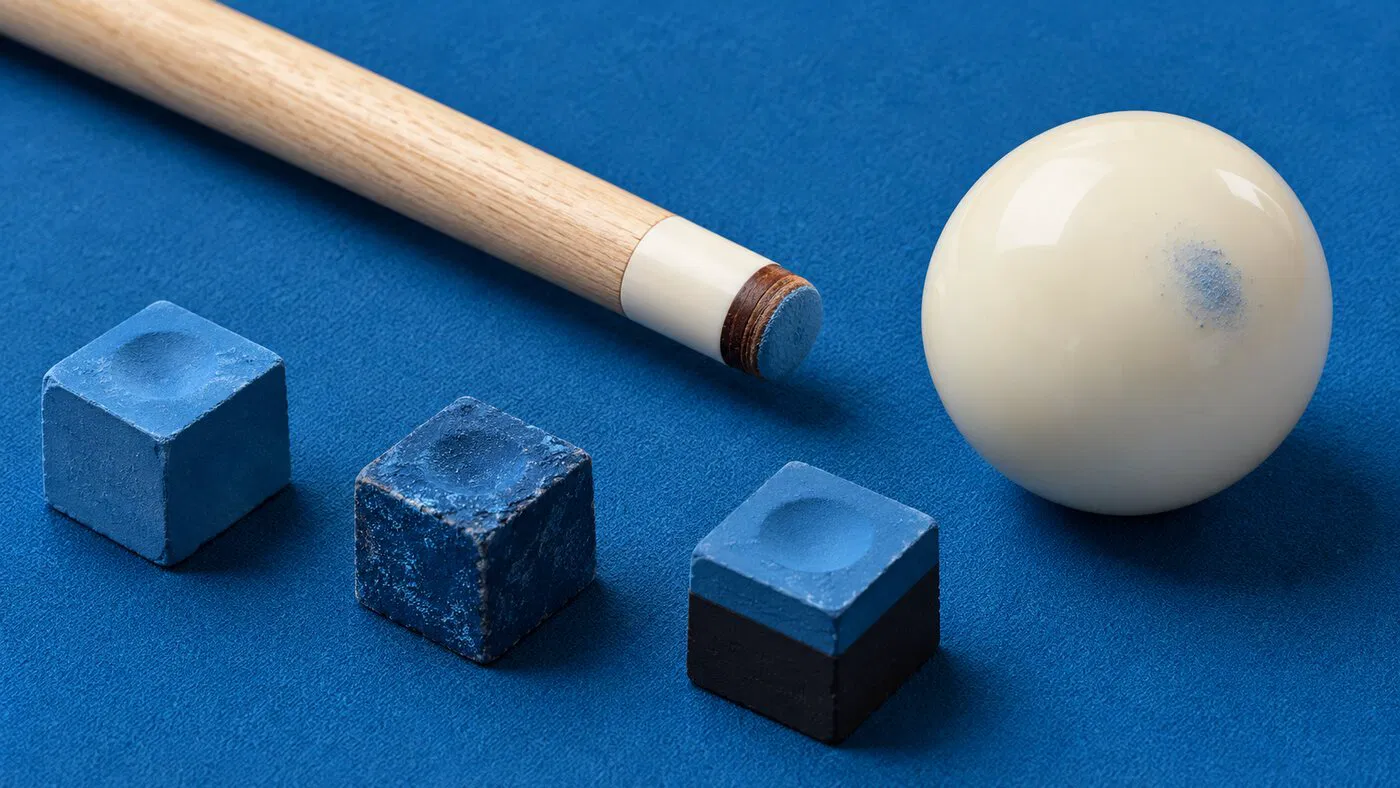
No—expensive pool chalk does not automatically create more cue-ball spin. When a suitable chalk is applied properly to a maintained leather tip, maximum usable spin is governed mainly by tip contact point and the practical miscue limit, not the price printed on the chalk package.
What Does Pool Chalk Actually Do?
Chalk helps the cue tip grip the curved cue-ball surface during the extremely brief impact. That grip is essential when the tip contacts away from center to create sidespin, follow, or draw.
Without enough chalk, the tip can slide across the ball instead of maintaining useful contact. The familiar sharp sound, erratic cue-ball reaction, and chalk mark from that slip are signs of a miscue.
Chalk does not act like a magic spin coating. Its basic job is to provide dependable grip within a practical contact zone.
Does Premium Chalk Create More Spin?
Controlled comparisons summarized by Dr. Dave Alciatore found no measurable difference in the maximum-spin miscue limit among the tested chalks when the tip was chalked properly before the shot.
That distinction matters. Some products may stay on the tip longer, create less visible mess, transfer differently to the cue ball, or feel easier to apply. Those can be legitimate reasons to prefer one product. They are not the same as proving that a more expensive chalk produces a wider safe contact limit or more maximum spin.
| Chalk Claim | What It Can Mean in Practice | What It Does Not Prove |
|---|---|---|
| Stays on longer | Fewer applications may be needed | More maximum spin |
| Cleaner formula | Less residue on hands, cloth, or ball | A wider miscue limit |
| Smooth application | Easier, more even tip coverage | Better stroke mechanics |
| Higher price | Different packaging, materials, or user experience | Automatic performance gain |
If you chalk before every demanding spin shot, brand differences in retention become less important. If you dislike frequent chalking or often forget, a product that remains effective longer may provide practical convenience.
Why Can More Friction Stop Helping?
The cue ball presents a steeper surface to the tip as contact moves farther from center. Near the normal miscue boundary, tip and ball dynamics become more complex than a simple friction number.
Testing cited by Dr. Dave suggests that once the contact reaches that boundary, additional chalk friction does not keep expanding the usable zone. The tip is increasingly pushed away from the sloping ball surface, and the chalk particles can no longer maintain the same effective grip.
The result is a practical limit: freshly applied chalk is essential, but more expensive chalk cannot make an extreme contact point mechanically safe forever.
Does a Soft Cue Tip Produce More Spin Than a Hard Tip?
Not in the simple way many players assume.
With equal cue-ball speed and the same effective tip offset, typical playing-tip hardness has little practical effect on the amount of spin. A hard playing tip can apply as much spin as a soft one when both are maintained and chalked correctly.
Soft tips compress more and usually feel quieter or softer at impact. They may also hold chalk more easily, especially compared with a glazed or super-hard surface. Hard tips often keep their shape longer and may feel more direct.
| Tip Characteristic | Softer Playing Tip | Harder Playing Tip |
|---|---|---|
| Sound and feel | Softer, more muted | Firmer, sharper |
| Chalk retention | Often easier | Requires attention if surface glazes |
| Shape maintenance | Can mushroom or change faster | Usually holds shape longer |
| Maximum spin when maintained | Comparable | Comparable |
| Best choice | Personal feel and maintenance preference | Personal feel and durability preference |
The most important equipment requirement is that the tip holds chalk consistently and remains in good condition.
What Causes a Pool Miscue?
A miscue occurs when the cue tip slips during contact instead of gripping the cue ball cleanly. Common causes include:
- Insufficient or uneven chalk coverage.
- A glazed, polished, or contaminated tip surface.
- Contact beyond the practical miscue limit.
- Unintended sideways movement during the stroke.
- Addressing one point and striking another.
- Extreme cue elevation combined with poor contact.
- Moisture, oil, dirt, or excess residue on the tip or cue ball.
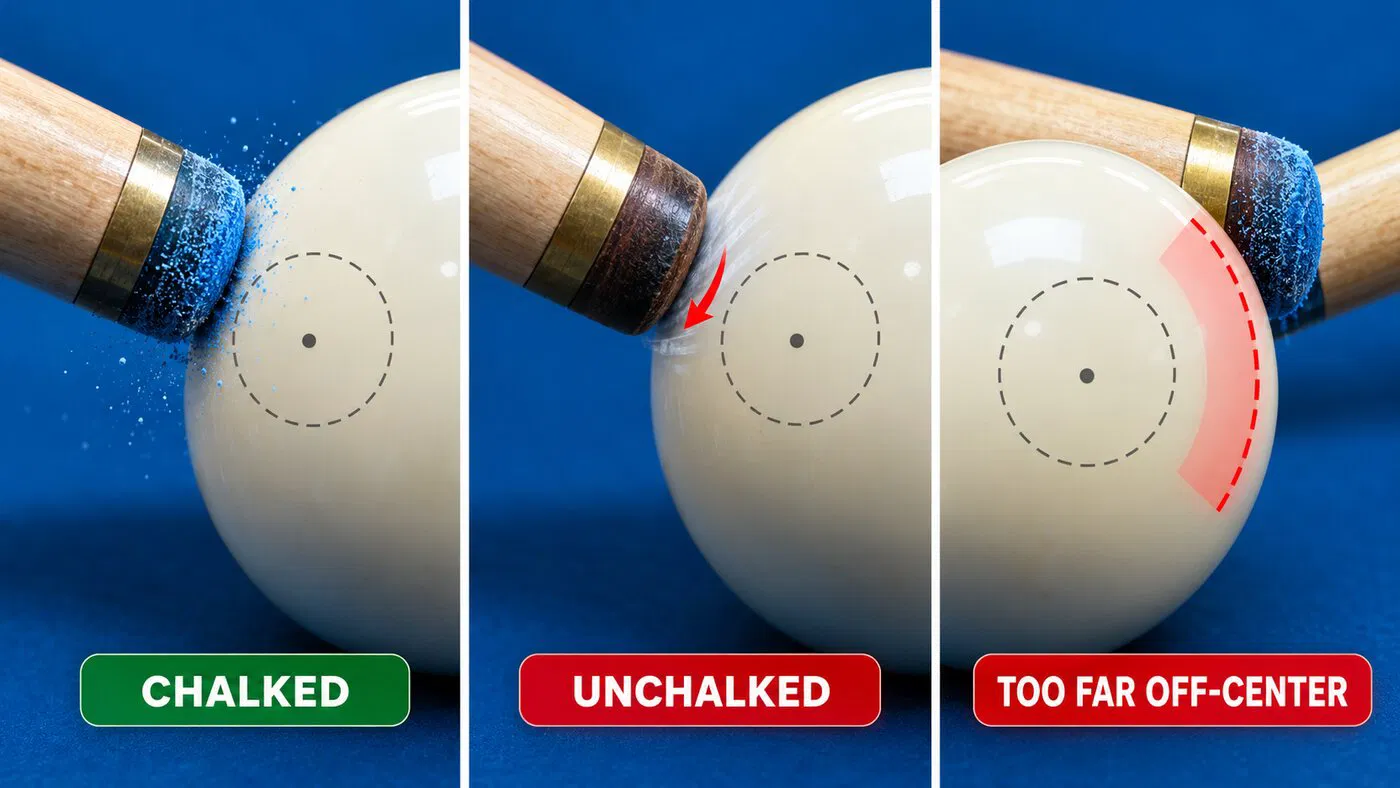
Good chalk coverage protects normal off-center contact, but it cannot rescue a hit placed beyond the practical miscue limit. Original illustration created for Billiard News.
The diagram separates two problems that players often confuse. A tip can miscue inside the normal range because it lacks grip, while a fully chalked tip can still miscue because the intended contact point is too far from center.
How Should You Chalk a Cue Tip?
Use several light brushing motions to cover the entire playing surface of the tip. Rotate the cue or the chalk so the coating reaches the edge instead of leaving an unchalked ring.
Avoid drilling a deep hole into the center of the chalk cube. That habit can leave coverage around the tip edge inconsistent and may mark the ferrule.
Before a high-spin shot:
- Inspect the tip under good light.
- Apply a thin, even coating across the full dome.
- Confirm that no dark leather patches remain near the intended contact area.
- Keep the ferrule out of the chalk.
- Clean visible chalk accumulation from the cue ball during practice when appropriate.
Chalking should become part of the pre-shot routine without distracting from aiming and speed control.
How Does Tip Shape Affect Contact?
A playing tip needs a consistent rounded profile so different off-center contacts present a predictable surface to the cue ball.
A tip that has become unusually flat, mushroomed, glazed, chipped, or uneven can make edge contact less dependable. The solution is maintenance, not endless aggressive scuffing.
Lightly restore the surface only when it is no longer accepting chalk. Removing material after every session shortens tip life and can change the shape unnecessarily.
If the leather separates, cracks, becomes too thin, or will not hold chalk after reasonable maintenance, replacement is more sensible than continued reshaping.
Why Do Players Feel More Spin After Changing Chalk or Tips?
Several real changes can create that impression without proving a higher physical spin limit.
A new product may encourage the player to chalk more carefully. A freshly installed tip has a clean, consistent shape. Confidence can also lead to a more committed stroke or a farther-off-center contact point.
Cue-ball speed complicates comparisons. A faster shot loses less spin before reaching the object ball or cushion, so the reaction may look stronger even when the tip generated the same spin-to-speed relationship at impact.
To compare equipment fairly, control tip offset, cue-ball speed, shot distance, ball condition, and application method. Casual before-and-after impressions rarely control all of those variables.
How Can You Compare Two Chalks Without Fooling Yourself?
Use this 18-shot editorial test for repeatability and convenience. It is not a laboratory measurement and should not be used to push contact beyond the normal miscue limit.
Choose one familiar sidespin shot with a moderate tip offset. Keep the cue, tip, balls, table, target, and intended speed unchanged.
| Group | Condition | Shots |
|---|---|---|
| A | Chalk 1, applied before every shot | 6 |
| B | Chalk 2, applied before every shot | 6 |
| C | Preferred chalk, applied once at the start | 6 |
For each shot, record:
- Whether the hit was clean or miscued.
- The cue ball's target result.
- How evenly the chalk covered the tip.
- Visible transfer to the cue ball.
- Mess left on the cloth, hand, or ferrule.
- Whether the application felt easy and repeatable.
Groups A and B compare freshly applied performance. Group C explores retention and convenience. Do not interpret a small sample as proof that one chalk creates more maximum spin.
What Should You Pay For When Buying Chalk?
Pay for features you can actually use:
- Reliable availability.
- Easy and even application.
- Low mess or reduced transfer, if that matters to you.
- Retention that matches your chalking habits.
- A holder or shape that fits your routine.
- A price that makes replacement painless.
A premium option can be worthwhile because it is cleaner, lasts longer, or feels better in daily use. It does not need a maximum-spin advantage to justify the purchase.
For many league players, a dependable inexpensive chalk applied correctly before important shots performs the core task perfectly well.
How Should You Choose a Cue Tip?
Choose a playing tip by balancing feel, sound, shape retention, chalk holding, maintenance, and personal confidence.
Do not expect a soft label to supply spin automatically. Do not assume a hard label prevents spin. Typical leather playing tips can perform well across the hardness range when the surface is healthy and properly chalked.
After installing a different tip, allow time to adapt to its hit efficiency and feel before drawing conclusions. Consistency with one well-maintained setup is usually more valuable than frequent equipment changes.
Does expensive pool chalk create more spin?
Not automatically. Tests summarized by Dr. Dave found no measurable maximum-spin miscue-limit advantage among the chalks compared when each was freshly and properly applied.
Why buy premium chalk if it does not add maximum spin?
It may stay on longer, apply more smoothly, create less mess, or fit a player's routine better. Those are convenience and consistency benefits.
Does a soft cue tip create more spin?
Not under a controlled comparison with equal cue-ball speed and tip offset. Typical soft and hard leather playing tips can reach comparable usable spin limits when maintained and chalked.
Why do I miscue even after chalking?
The contact may be too far from center, the tip may be glazed or damaged, or the stroke may deliver the tip somewhere other than the intended point.
Should I chalk before every shot?
Frequent light application is a dependable habit, especially before shots using significant follow, draw, or sidespin.
When should a cue tip be replaced?
Replace it when it is cracked, separating, excessively thin, badly misshapen, or unable to hold chalk after reasonable maintenance.
What Is the Final Takeaway?
Chalk matters because off-center contact needs grip. Tip condition matters because the chalk needs a sound surface to hold. Neither price nor softness removes the practical miscue limit.
Choose products for consistency, cleanliness, feel, durability, and convenience. Then build the habits that matter most: maintain the tip, apply chalk evenly, control the stroke, and keep the intended contact point inside a usable range.