How to Choose a Pool Boot Camp That Fits Your Skill Level
Use the curriculum and your actual practice needs to choose the right starting point.
Choose a pool training course by the skills you need to work on, rather than the word "advanced" in its title. A useful course should give you room to ask basic questions, receive feedback, and leave with practice you understand.
Billiard University's Boot Camps provide an example of two different entry points. Its official page describes three-day courses in Fort Collins, Colorado, with instruction adapted to the individual. The Overview Course welcomes beginner through advanced players; the Advanced Course is intended for previous Overview students or players already proficient in its topics.
The checklist below is our editorial guide to evaluating that choice, not an additional set of BU admission requirements.
What separates an overview from advanced instruction?
BU's Overview curriculum includes stroke fundamentals, cue-ball control, planning, and introductory bank and kick systems. Its Advanced curriculum revisits fundamentals before moving into more demanding position play, spin, and shot systems.
Both descriptions include video analysis. BU recommends the Overview option when a player is uncertain which course fits.
Don't treat the broader course as something you have to outgrow before asking for help. Read its topics one by one. If a term is familiar but you can't explain how you use it at the table, put it on your question list.
How can you describe your needs before enrolling?
Our suggestion is to prepare a few concrete examples from ordinary play. "I struggle to control distance on follow shots" tells an instructor more than "I want better position."
Separate what happened from what you think caused it. A missed shot is an observation; blaming your grip is a diagnosis you may need help checking.
A short preparation note can use this structure:
| Record | Example |
|---|---|
| Situation | A familiar follow shot |
| Intended result | Cue ball reaches the chosen area |
| Actual result | It repeatedly finishes short |
| Question | What should I check first? |
The example is a way to communicate with a coach. It isn't a formal assessment or a substitute for the course's own instructions.
What should you ask about the learning format?
BU says students work with a partner and share a table. Ask how a course organizes feedback and practice time before assuming it consists entirely of private instruction.
For your own planning, consider how you prefer to take notes and revisit demonstrations. Bring a notebook or another method the organizer permits. Ask before recording instructors or classmates.
Tell the instructor about physical limitations relevant to your participation. Ask what adjustments may be possible instead of forcing yourself into a setup you can't comfortably repeat.
What costs and arrangements need checking?
BU states that meals, transportation, and lodging are outside its course fee. Confirm the current dates, availability, payment terms, and total trip cost directly before booking.
Our recommendation is to keep course confirmation separate from travel arrangements. A published schedule isn't the same as a confirmed reservation in your name.
Make a small planning sheet for the course fee, travel, accommodation, and time away from work. Leave unknown amounts blank until verified. That is more useful than underestimating the trip with a single headline price.
How should you turn feedback into practice afterward?
Before leaving, ask which change deserves your first attention and how to practice it. Write down the exercise as you understand it, then check your notes with the instructor.
Our suggested follow-up record has three parts: the task, what you observed, and the question you still have. Keep any original assessment results separate from experimental practice attempts.
Avoid making every suggested change at once simply because you have several pages of notes. Agree on an order with your instructor. A clear first priority gives the next practice session a purpose without promising an immediate jump in match results.
What do the course photographs show?
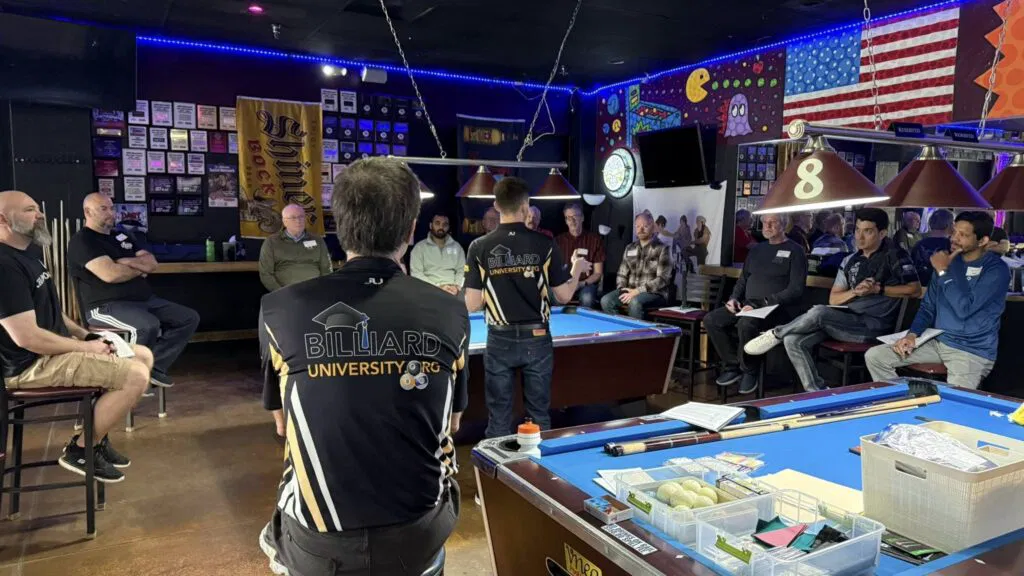
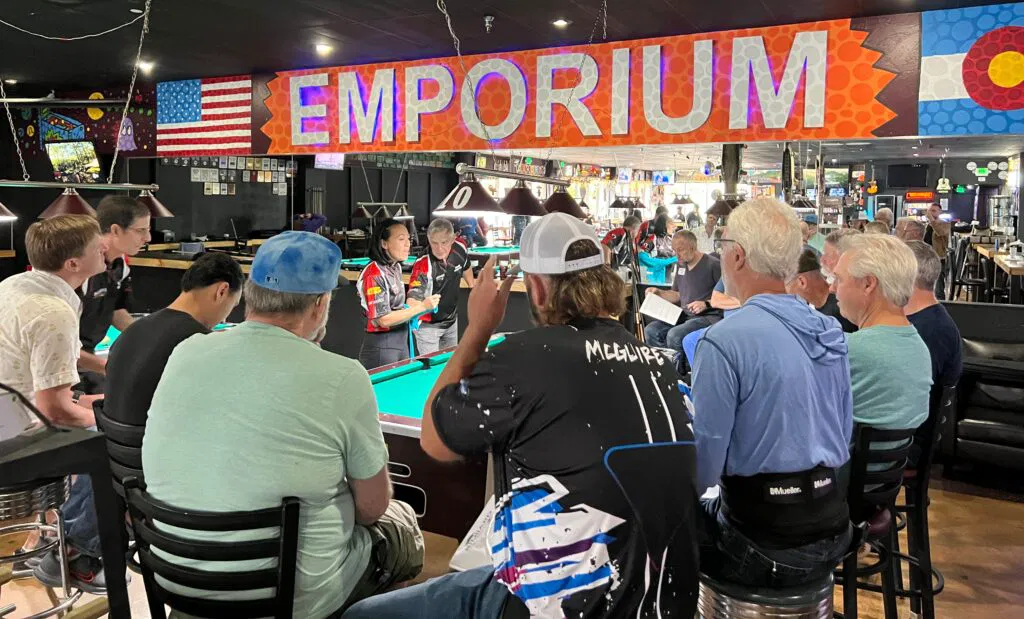
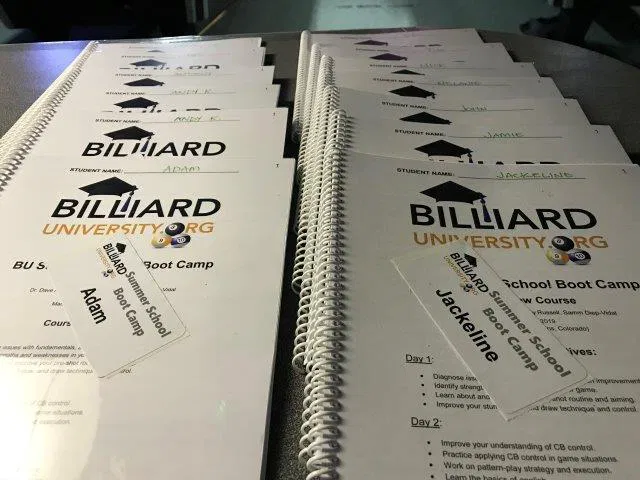
These images are from BU's official Boot Camp page. They show instructors, course materials, and past training groups; they do not establish availability for a future session or guarantee a particular result for a new student.







Is the Overview Course only for beginners?
No. BU describes it as suitable for beginner through advanced players.
Does choosing an advanced course eliminate fundamentals work?
No. BU includes a fundamentals checkup in its Advanced curriculum.
Should I book travel from the schedule alone?
Our recommendation is to confirm your place and the applicable arrangements with the organizer first.
Source: Billiard University — Boot Camps