What Your BU Pool Rating Means and Where Its Limits Are
Read the score in context before turning an assessment result into a claim about your competitive level.
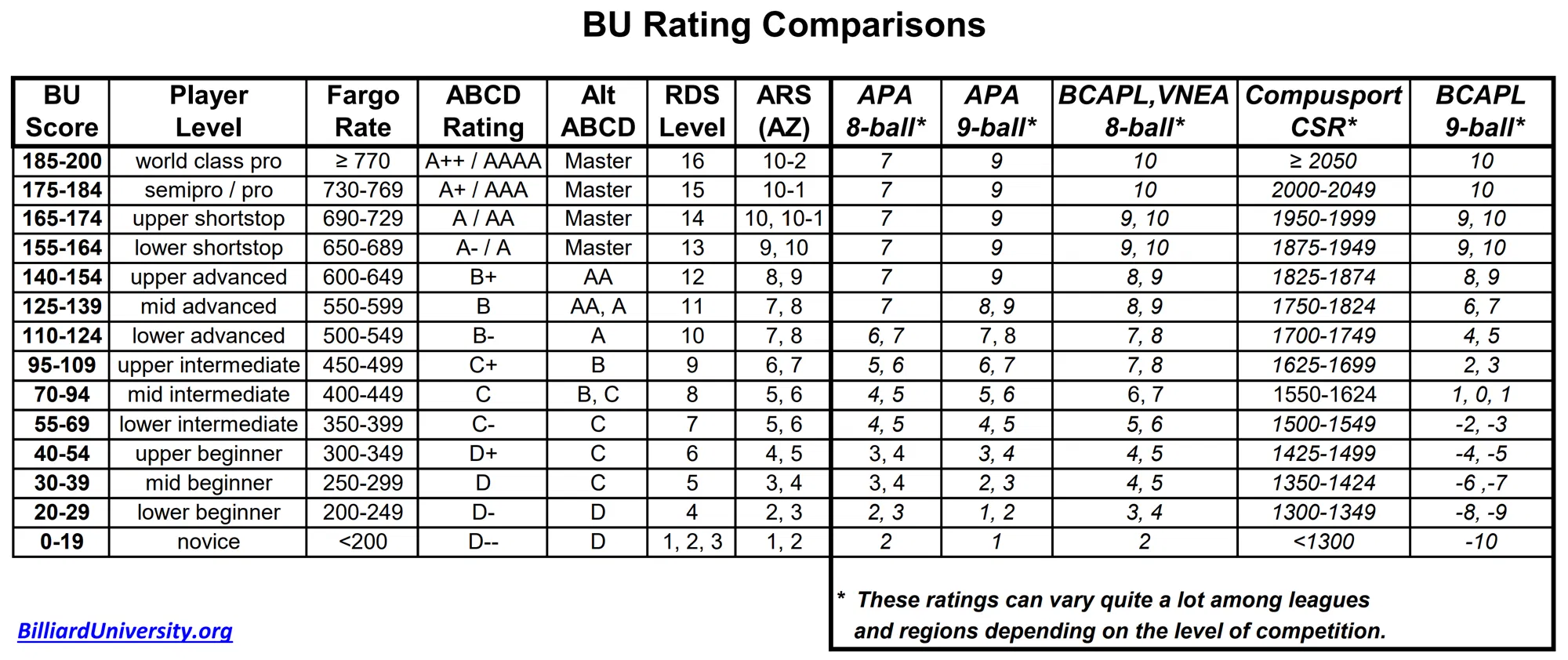
A practice score is useful only if you know what it measures. Before treating a number as your playing identity, check the system behind it, the conditions of the attempt, and how much you have practiced that exact test.
Billiard University's scoring page makes an important distinction: its rating comes from individual exam performance, rather than match results against other players. It also acknowledges a limitation. With extensive repetition, familiar drills increasingly measure execution of those exercises rather than overall playing ability.
What does a BU score measure?
BU adds Exam I and Exam II to produce its overall score. Its published playing-level ranges are:
| BU score | BU player level |
|---|---|
| 180-200 | Pro |
| 160-179 | Semi pro |
| 140-159 | Advanced-3 |
| 125-139 | Advanced-2 |
| 110-124 | Advanced-1 |
| 95-109 | Intermediate-3 |
| 70-94 | Intermediate-2 |
| 55-69 | Intermediate-1 |
| 40-54 | Beginner-3 |
| 30-39 | Beginner-2 |
| 20-29 | Beginner-1 |
| 0-19 | Beginner-0 |
Read these as labels within the BU assessment. A category name alone doesn't establish tournament results or a separate organization's rating.
Why shouldn't you use a comparison chart as a league credential?
A reference chart can help explain a scale, but it doesn't enroll you in a league or determine your eligibility for an event. Check the organizer's actual entry requirements when entering a competition.
For everyday discussion, describe the result precisely: "I scored 112 on the BU exams" communicates more than "I'm a B player." The first statement identifies the test and the outcome. The second leaves the listener guessing which classification you mean.
Our editorial recommendation is to keep assessment records and competition records separate. Both may be useful, but combining them into one unsupported label makes later comparisons harder.
Can two results be compared if the tables differ?
BU provides a Table Difficulty Factor procedure and calculator for putting results on different tables into perspective. Use that published method if you want an adjusted comparison rather than inventing a bonus for a table you consider difficult.
For your own notebook, retain the unadjusted score as well. Record the table and date beside it, and identify any adjusted figure clearly. You should be able to tell later whether a number came directly from a score sheet or from an additional calculation.
If you didn't record the information needed for an adjustment, leave that uncertainty visible. "Different table, no adjustment calculated" is an adequate note. Guessing creates a more precise-looking record without making it more informative.
What does an improved score tell you after repeated practice?
An increase is worth examining at the drill level. Which exercises improved? Did the gain appear across several attempts, or did one unusually strong session account for most of it?
As a suggested review method, keep your first assessment, your recent results, and brief practice notes together. That lets you distinguish a baseline attempt from a later attempt after concentrated work on the layouts.
You can also maintain a separate match notebook. Record concrete decisions you want to revisit, such as choosing a difficult position route or attempting a pot without considering a safety. These are prompts for discussion with a coach, not extra BU scoring criteria.
Don't add these observations to the exam total. Their value is in preserving context that a total cannot contain.
How can you turn the number into a useful next step?
Choose a question you can investigate rather than chasing a label. For example: "Why do my results on this exercise vary so much?" is a workable practice question even if your overall category hasn't changed.
Our suggested record has four fields: the exact test version, the date, the score, and one observation to review. Keep the observation descriptive. "Cue ball finished long on several attempts" preserves what happened without guessing the mechanical cause.
Is a BU score based on match wins?
No. BU derives it from Exam I and Exam II performance.
Does a high test score automatically change my league rating?
No. Consult the league or event organizer about its own rating and eligibility process.
Should I discard my original score after calculating an adjustment?
Our recommendation is to keep both and label them clearly so the calculation remains traceable.