BU Ratings Explained: Exam Scores to A–D Player Levels
A 0–200 exam score that translates directly into the letter ratings league players already know.
Every serious player has been asked the same question in a pool room: “What’s your speed?” League systems answer it with letters and numbers that shift from one region—or one league—to the next. Billiard University (BU) takes a different approach: it puts a number on playing ability that is earned on the table, by you alone, and means the same thing everywhere.
The result is a 0–200 score that maps directly onto the letter ratings players already know. Here is how the system works and how to read it.
How is a BU score calculated?
Your BU score is simply the sum of two playing-ability exams—Exam I + Exam II—for a maximum of 200 points. The exams are standardized sets of shots and drills that are administered and scored under fixed conditions, not averaged from match results.
That distinction matters. League handicaps like APA skill levels or BCAPL ratings are computed from wins, losses and innings against other people, so the same letter can mean different things in different cities. The BU number measures only your own execution, which is why BU says its ratings stay meaningful across regions and internationally.
From score to level: the full conversion table
Once you have a total, BU converts it to a named player level and a traditional A–D rating:
| BU Score | BU Player Level | Traditional Level | Traditional A–D Rating |
|---|---|---|---|
| 180–200 | pro | touring pro | A+++ |
| 160–179 | semi pro | semi pro (master) | A++ (AAA) |
| 140–159 | advanced-3 | tournament player (expert) | A+ (AA) / A |
| 125–139 | advanced-2 | upper advanced | A-/B+ |
| 110–124 | advanced-1 | lower advanced | B/B- |
| 95–109 | intermediate-3 | upper intermediate | B-/C+ |
| 70–94 | intermediate-2 | mid intermediate | C+/C |
| 55–69 | intermediate-1 | lower intermediate | C |
| 40–54 | beginner-3 | upper beginner | C- |
| 30–39 | beginner-2 | mid beginner | D+ |
| 20–29 | beginner-1 | lower beginner | D |
| 0–19 | beginner-0 | absolute novice | D- |
How do you read your result?
Work through one example. Say you take both exams and score 55 on Exam I and 60 on Exam II—a total of 115. That lands you in the 110–124 band: advanced-1, equivalent to a “lower advanced” player carrying roughly a B to B- rating in traditional letter terms.
A few things worth noticing in the table:
- The bands are not equal in size. Intermediate and beginner levels span about 15 points each, while the pro and semi-pro tiers demand 20-point jumps—progress gets harder at the top.
- The crossover to “advanced” sits around 110. Below that you are an intermediate player; at 140 you are in territory BU calls “tournament player (expert).”
- Pro starts at 180. That is 90% of the maximum—BU reserves its top label for genuinely elite execution.
How does BU compare to Fargo, APA and other systems?
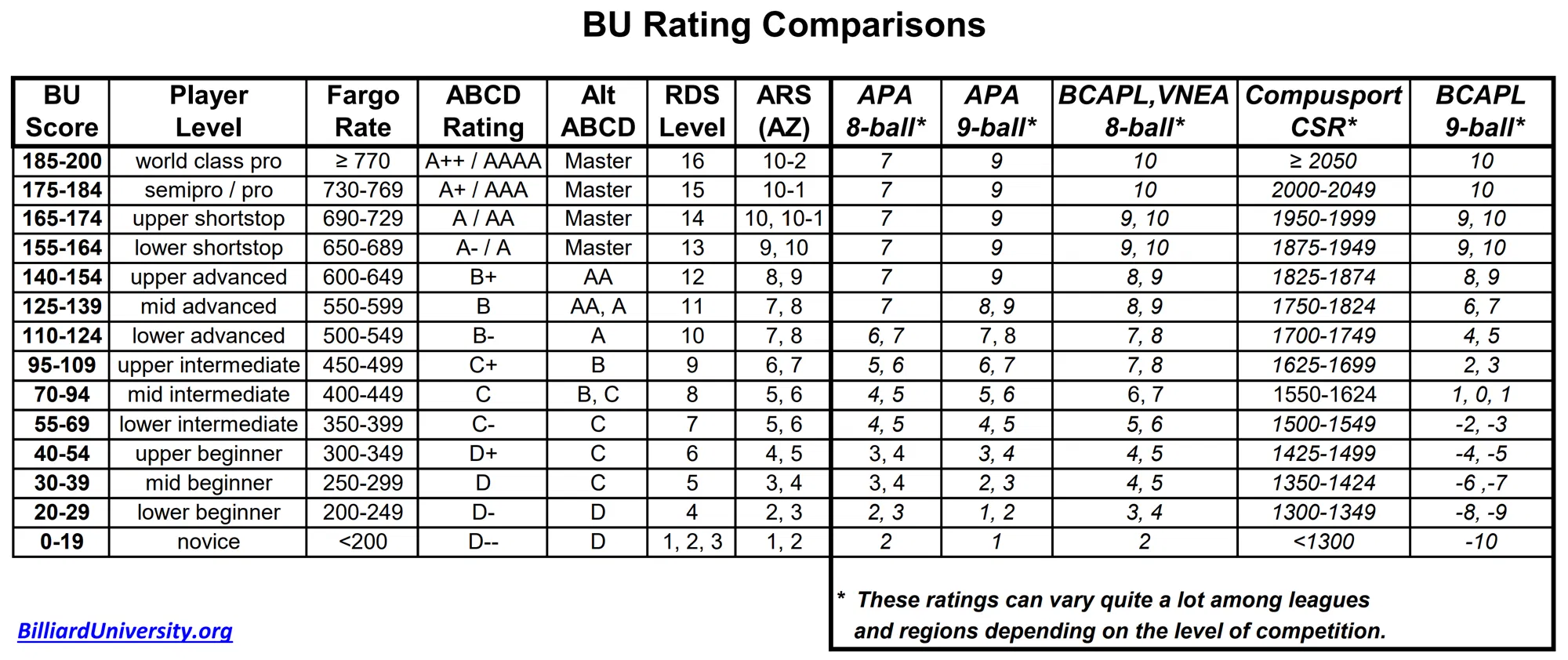
BU publishes an official comparison chart that lines its score ranges up against Fargo Rate, the ABCD letter scale, APA 8-ball and 9-ball skill levels, BCAPL/VNEA numbers and Compusport CSR. A few anchors from the chart: a BU score of 185+ corresponds to roughly Fargo 770 or higher, while the 110–124 “lower advanced” band sits near Fargo 500–549 and APA 6–7 in 8-ball.
BU itself cautions that league-based columns “can vary quite a lot among leagues and regions depending on the level of competition”—treat those equivalences as orientation, not exact conversions.
Can your score earn you a diploma?
Yes. The same 0–200 total doubles as BU’s diploma track:
| BU Score | Diploma Earned |
|---|---|
| 55–84 | Bachelors |
| 85–99 | Bachelors with Honors |
| 100–124 | Masters |
| 125–139 | Masters with Honors |
| 140–179 | Doctorate |
| 180–200 | Doctorate with Honors |
Qualifying scores can be submitted through BU’s online diploma application for official recognition.
What are the caveats?
Two honest limits are worth knowing before you chase a number:
- Table difficulty is adjustable, not equal. BU offers a Table Difficulty Factor (TDF)—a multiplier computed from your table’s measurements—so scores on easy home tables can be put in perspective against scores on tougher equipment.
- The exams can be gamed by practicing the drills. BU acknowledges that after many attempts, some drills start measuring execution of the test rather than overall playing ability. The first few sittings are the most honest read of your game.
Why bother getting a number at all?
Because a score turns “I think I’m improving” into something checkable. A BU result gives you a baseline, a level name other players understand, and—if you pair it with retesting—a way to prove that a training block actually worked. For players who have never had a league rating, or who suspect their league letter does not travel well, it is the closest thing pool has to a standardized yardstick.
What is the maximum BU score?
200 points—the combined maximum of Exam I and Exam II. Scores of 180 or better are rated “pro.”
What BU score counts as “advanced”?
Advanced-1 begins at 110. The 140–159 band (advanced-3) corresponds to what BU calls a tournament player or expert.
Is a BU rating the same as a league handicap?
No. League handicaps are computed from match results against other players and vary by league and region. A BU score comes from standardized exams measuring only your own performance, so it is intended to be comparable anywhere.
Do BU scores expire?
The rating itself does not expire, but BU notes that repeatedly practicing the exam drills can inflate later scores, so early sittings tend to reflect true playing ability best.
Sources
- Billiard University: Scoring and Rating — all score ranges, levels, A–D mappings, diploma tiers, TDF and chart comparisons
- BU Rating Comparisons chart — official chart via BilliardUniversity.org