Combination Shots Without Guesswork: Two-Line Aim & 15-Shot Drill
Solve the shot backward, execute it forward and use a simple score to expose the real source of each miss.
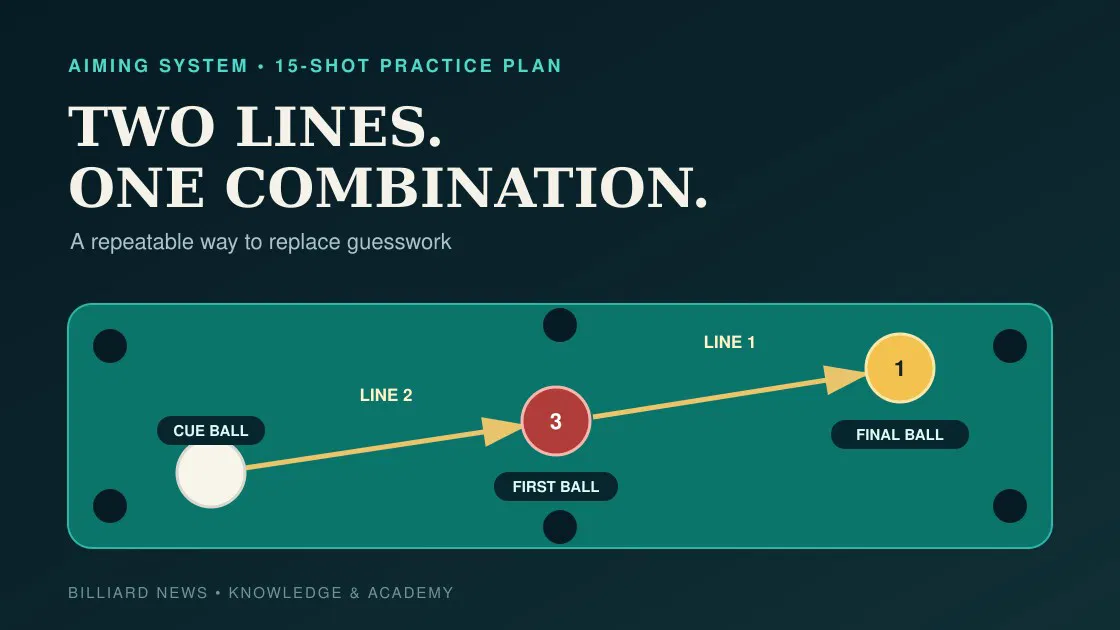
A combination shot becomes repeatable when you solve it as two separate aiming lines: first send the final object ball toward the pocket, then send the first object ball into the required contact point. Work backward to find the targets, then shoot forward with a controlled, center-ball stroke.
The method removes much of the visual guesswork, but it does not erase physics. Distance, speed, cut-induced throw and the gap between the object balls still determine how forgiving the shot will be.
What are the two aiming lines?
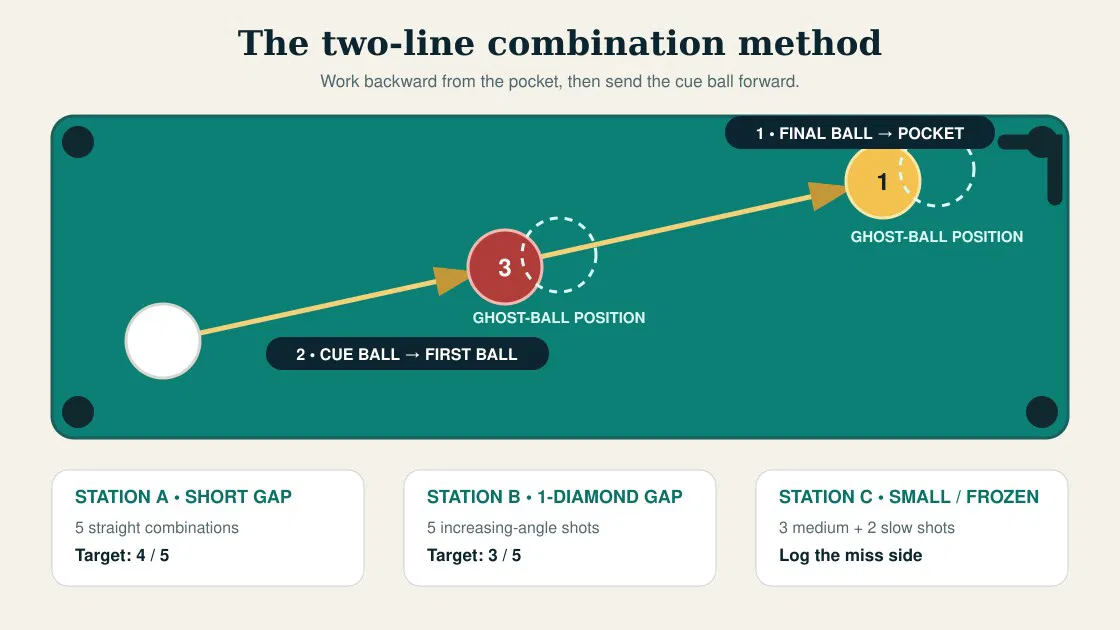
Line 1 runs from the final object ball to the called pocket. Visualize the ghost-ball position that would send that ball down the pocket line.
Line 2 runs from the cue ball through the first object ball. The first object ball must arrive at the ghost-ball position you found for Line 1. In other words, apply your normal aiming system twice.
Use this sequence before getting down:
- Trace the final ball’s center to the center of the pocket.
- Locate its ghost-ball contact position.
- Treat that position as the “pocket” for the first object ball.
- Locate the first ball’s ghost-ball position from the cue ball.
- Settle into the stance only after both lines are clear.
Why are short combinations easier?
Any angular error in the first collision continues into the second collision. When the object balls are far apart, a small directional error has more distance to grow before the first ball reaches the final ball. Keeping the gap short generally makes the combination more tolerant.
The final ball is also easier to pocket when it is close to the pocket. A short final segment reduces how far an imperfect line can drift.
This leads to a practical pattern rule: when choosing between combinations, prefer the layout with the shorter object-ball gap and the shorter final-ball path, assuming the cut angles are comparable.
How do speed and throw change the aim?
Start with center ball and a medium, smooth speed. It is the cleanest baseline for learning whether your geometry is correct.
Slow shots can create more throw, especially when the object balls are frozen or separated by only a small gap. The final ball may travel away from the pure geometric line. High speed can reduce some throw effects, but it also narrows pocket acceptance, sends balls farther and makes cue-ball control less predictable.
Do not make a throw adjustment after one miss. Repeat the same setup and look for a pattern. If several well-stroked attempts miss to the same side, make a small aim or speed adjustment and test again.
What is the 15-shot combination drill?
Mark every starting position so the test can be repeated. Use a reinforcement ring, chalk mark or small piece of removable paper rather than estimating the layout each time.
| Station | Setup | Five-shot goal |
|---|---|---|
| A: Short gap | Straight combination; final ball near the pocket; object balls a few inches apart | Make at least 4 of 5 |
| B: One-diamond gap | Same basic line, but move the first object ball about one diamond away | Make at least 3 of 5 |
| C: Small-gap or frozen | Place the object balls very close or frozen; shoot three at medium speed and two slowly | Record make rate and miss side |
Score each attempt with 2 points for a make, 1 for a jawed ball, 0 for a clean miss or foul, and minus 1 for a scratch. The maximum is 30. More important than the total is the miss pattern: left, right, short, overcut or undercut.
How should you diagnose a consistent miss?
- Final ball misses the same side: Recheck the first object ball’s contact point and test a small throw compensation.
- Miss direction changes randomly: The stroke or speed is probably inconsistent; return to Station A.
- First object ball reaches the wrong side of the target: Recheck Line 2 and your cue-ball-to-first-ball aim.
- Pocketed ball but poor cue-ball result: Keep the same pocketing line and change speed or tip position only after the make is stable.
Video from directly above or from the shot line can reveal whether the first object ball actually traveled along the intended second line. A single still frame at contact is often more useful than judging from memory.
What must be called in a combination shot?
Under WPA standard call-shot rules, the intended ball and pocket must be indicated when the shot is not obvious. Details such as cushions or intermediate balls do not need to be called. CSI rules similarly center the call on the ball and pocket.
When there could be confusion, state the combination clearly before shooting. A correct shot can still become a dispute if the intended ball or pocket was not understood.
What should a 20-minute practice session look like?
Spend three minutes on Station A without keeping score, then complete all 15 scored attempts. Use the final five minutes to repeat only the station with the clearest miss pattern. Record the date, score, speed and dominant miss side.
The goal is not to memorize one table layout. It is to train a process: find Line 1, transfer it to Line 2, choose a controlled speed and observe the result.
Which line should I visualize first on a combination?
Start with the final object ball’s path to the pocket, then work backward to the first object ball and cue ball.
Should I use side spin on the drill?
Begin with center ball. Add side spin only when position play requires it and your center-ball result is already consistent.
Why do frozen combinations miss differently?
Frozen or very small-gap object balls can produce more throw, so the final ball may depart from the pure geometric line.
What is a good first benchmark?
Aim for 4 of 5 at Station A and 3 of 5 at Station B while recording the miss side at Station C.