Ball-in-Hand Strategy: Solve the Table, Not Just One Shot
Use ball-in-hand to solve problem balls, preserve useful angles, plan backward from the game ball, and keep a safety option.
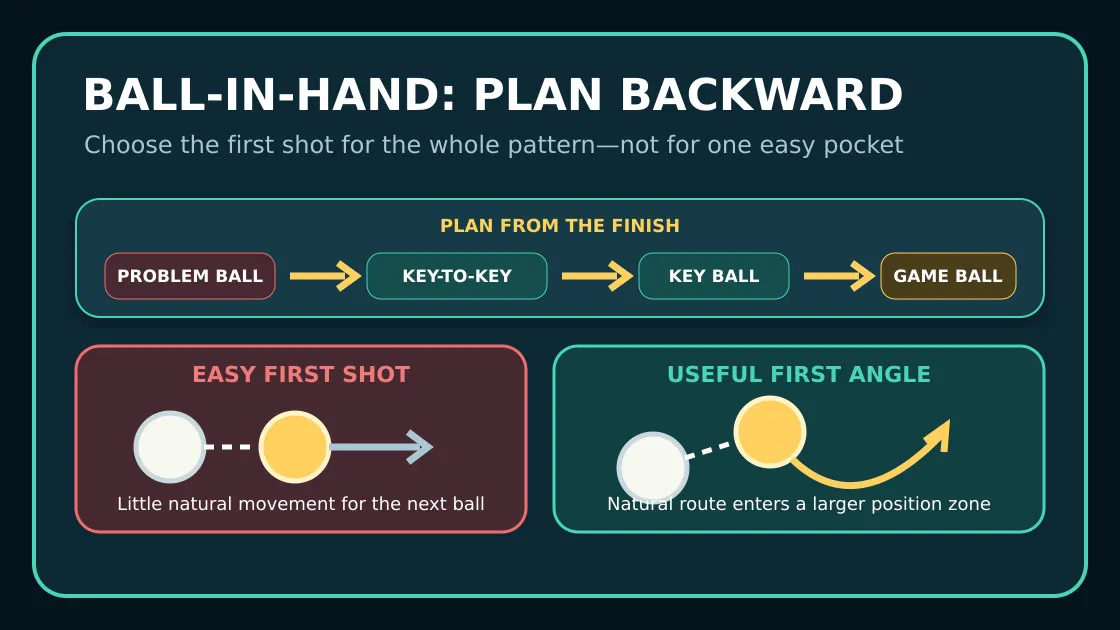
The best ball-in-hand position is the one that simplifies the whole rack—not necessarily the position that creates the closest, straightest, or easiest first shot. Use the freedom to solve a problem ball, preserve a useful angle, build a route to the game ball, and keep a safety option when the runout is not reliable.
That change in mindset turns ball-in-hand from a free pocket into a planning advantage.
What Does Ball-in-Hand Allow Under WPA Rules?
Under Rule 1.6 of the current WPA Rules of Play, a player with cue-ball in hand may place the cue ball anywhere on the playing surface and continue moving it until a shot is executed.
The player may use any part of the cue stick, including the tip, to reposition the cue ball, provided the movement is not a forward stroke. Certain games and most break shots can restrict placement to the area above the Head String, so the discipline-specific rule still matters.
Other organizations can use different procedures. Always confirm whether the match follows WPA, APA, CSI, or local rules before moving the cue ball.
The strategic value is larger than the legal privilege. Ball-in-hand lets you select:
- the first shot;
- the cut angle;
- the cue-ball path after contact;
- the bridge-hand space behind the cue ball;
- the order of the remaining balls; and
- whether to attack, solve a problem, or play safe.
Why Can the Easiest First Shot Be the Wrong Shot?
A straight shot often looks perfect because it reduces the chance of missing. But a straight hit also removes the natural cut angle that sends the cue ball toward the next position zone.
The player may then need force draw, sidespin, or a long route on the second shot. The first ball was easy, but the pattern became harder.
A controlled 10-to-20-degree cut can be better when it lets the cue ball:
- roll naturally toward the next ball;
- contact a cushion at a predictable angle;
- enter a large position zone;
- preserve an angle for breaking a cluster;
- stay away from the rail; or
- avoid unnecessary sidespin.
Dr. Dave's cue-ball direction guide provides useful reference lines. A stun cue ball initially follows the tangent line, while a rolling cue ball heads roughly 30 degrees from its original line over a common range of cut angles. These are planning references, not exact guarantees for every speed and table.
What Five Questions Should You Answer Before Placing the Cue Ball?
1. Is the table actually runnable?
Walk around the table before committing to offense. Identify obstacles that can stop the run:
- a ball frozen to a rail with only one practical pocket;
- a cluster with no clean breakout angle;
- an opponent's ball blocking the route to the 8-ball;
- a narrow transition from the lowest ball to the next ball in 9-ball;
- no insurance ball after a breakout; or
- a position zone so small that one speed error ends the run.
If the table is not realistically runnable, ball-in-hand may be more valuable for a safety or a problem-solving shot than for pocketing the first available ball.
2. What is the biggest problem ball?
The problem ball is not always the hardest ball to pocket. It may be the only ball that can open a cluster, the only useful bridge into the 8-ball, or the ball whose position zone will disappear later.
Dr. Dave's 8-ball strategy guide recommends handling problem balls early, choosing the key ball carefully, planning backward from the 8-ball, and breaking clusters when an insurance ball is available.
Ball-in-hand gives you the cleanest opportunity to address that problem before fewer options remain.
3. What is the game-ball route?
Plan backward instead of starting with the easiest pocket.
- Where do you want the cue ball for the 8-ball or 9-ball?
- Which ball naturally delivers the cue ball to that position?
- Which earlier ball produces the correct angle on that key ball?
The final sequence is often:
problem ball → key-to-the-key ball → key ball → game ball
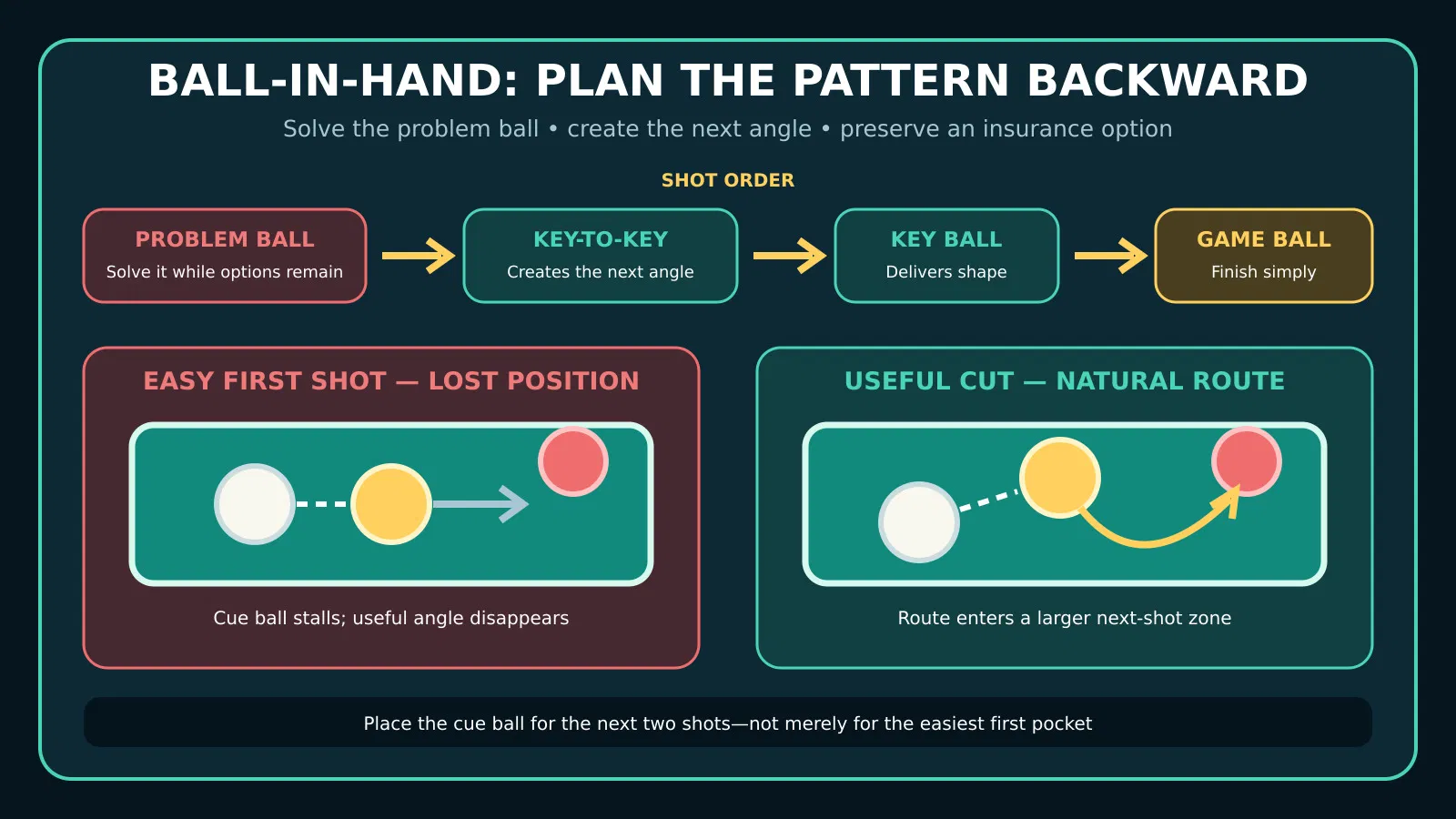
Use ball-in-hand to create the first useful angle in the entire sequence, not merely a straight opening shot.
4. Which first-shot angle creates the largest position zone?
Do not place the cue ball by looking only at the object ball and pocket. Look at the cue ball's exit path.
A useful angle should send the cue ball through the next position zone rather than across its narrowest edge. Coming into the line of the next shot allows a larger speed margin. Crossing the line at a sharp angle demands exact speed.
| First-shot choice | Immediate benefit | Hidden cost |
|---|---|---|
| Very straight and close | Highest pocketing confidence | Limited natural cue-ball movement |
| Small controlled cut | Natural path and larger position zone | Slightly harder first pocket |
| Heavy draw from straight | Can create movement without a cut | More speed and tip-contact risk |
| Sidespin route | Can change cushion angle | Adds squirt, swerve, and speed sensitivity |
| Safety or problem-solving shot | Preserves control when no runout exists | Gives up immediate offense |
Start with natural roll, stun, or simple follow whenever the table allows it. Add draw or sidespin because the pattern requires it—not because ball-in-hand makes a fancy position possible.
5. Is there room for the bridge hand and stroke?
Placing the cue ball extremely close to the object ball may shorten the shot, but it can also create:
- a cramped bridge;
- a short, rushed backswing;
- unwanted cue elevation;
- double-hit risk on close balls;
- poor sighting; or
- interference from a rail or nearby ball.
Before releasing the cue ball, inspect the space behind it. The hand, shaft, grip arm, and body must all fit the chosen line.
How Does the Decision Change in 8-Ball?
Imagine that stripes has three balls plus the 8-ball:
- one stripe is near a corner pocket;
- one stripe is near the center of the table;
- one stripe is close to a cluster of opponent balls; and
- the 8-ball has a clear side-pocket lane.
Placing the cue ball straight on the corner-pocket hanger gives the easiest first shot. It may also leave no useful angle to reach or open the stripe near the cluster.
A better plan may be:
- identify the clustered stripe as the problem ball;
- preserve the corner-pocket stripe as insurance;
- use ball-in-hand to cut the center-table stripe;
- send the cue ball naturally toward the problem area; and
- finish with the insurance ball as the key ball to the 8.
The first shot is slightly harder, but the rack becomes easier.
If the cluster cannot be opened with reasonable control, do not force a runout. Use ball-in-hand to play a safety that hides the cue ball while improving the problem ball.
How Does the Decision Change in 9-Ball?
Suppose the 2-ball is near a corner pocket and the 3-ball is across the table.
Placing the cue ball straight on the 2 may stop the cue ball near the pocket line. Reaching the 3 then requires a long draw shot or multiple cushions.
Instead, place the cue ball for a modest cut on the 2. At medium speed, the cue ball can roll to the long cushion and enter a broad position zone for the 3.
The comparison is not “easy shot versus hard shot.” It is:
- easy first shot followed by a difficult second shot; versus
- controlled first shot followed by an easy second shot.
In rotation games, check the next two transitions before placing the cue ball. A perfect position on the 3 is not useful if it leaves the wrong side of the 4.
When Is a Safety Better Than a Runout Attempt?
Choose defense when the table does not offer a high-confidence route to the game ball.
Ball-in-hand safety options include:
- hiding the cue ball behind a blocker;
- moving a problem ball toward a useful pocket;
- opening your cluster while leaving no direct shot;
- separating an opponent's key balls;
- placing the cue ball where a legal hit is difficult; or
- pocketing one problem ball before playing safe on the next shot.
The goal is not merely to leave the opponent without a pocket. The best safety also improves your future table.
| Table condition | Better default |
|---|---|
| Open layout with a clear game-ball route | Run out |
| One solvable cluster plus an insurance ball | Solve the cluster early |
| No reliable breakout and no insurance ball | Play safe |
| First shot is easy but the next position is tiny | Change the first-shot angle |
| Opponent has an easy runout if you miss | Prefer control over a low-percentage attack |
How Do You Practice the “Problem First” Decision?
Build three layouts:
- Layout A: three open object balls and one game ball.
- Layout B: one ball near a rail and two open balls.
- Layout C: two balls in a breakable cluster plus one insurance ball.
Run each layout three times for nine total attempts. Begin every attempt with ball-in-hand.
Before shooting, state or write:
- the complete ball order;
- the problem ball;
- the first cue-ball target zone;
- the key ball to the game ball; and
- the insurance or safety option.
How is the drill scored?
| Result | Points |
|---|---|
| Complete the rack using the declared route | 2 |
| Solve the problem ball but fail to finish | 1 |
| Miss the first shot, ignore the problem, or lose cue-ball control | 0 |
The maximum is 18 points.
Track the reason for every failure. A missed pocket, wrong angle, speed error, failed breakout, and poor decision are different problems and need different practice.
What Mistakes Waste Ball-in-Hand?
- Automatically choosing the straightest shot.
- Placing the cue ball too close to the object ball.
- Pocketing all easy balls before addressing a cluster.
- Planning only one shot ahead.
- Failing to identify the key ball for the 8 or 9.
- Using sidespin when a natural cue-ball route is available.
- Leaving the cue ball on a rail for the next shot.
- Breaking a cluster without an insurance ball.
- Attempting a runout when the table does not support one.
- Ignoring bridge-hand and backswing space.
- Applying WPA placement rules to a match using another rule set.
What Is the Final Ball-in-Hand Checklist?
Before you place the cue ball, ask:
- What can stop the run?
- Which ball must be solved first?
- What is my key ball to the game ball?
- What first-shot angle sends the cue ball into the largest position zone?
- Do I have space to bridge and stroke?
- What is the safety if the runout is not reliable?
The best placement makes the next several decisions easier. If it only makes the first pocket easy, it may not be the best placement.
Frequently Asked Questions
Should ball-in-hand always create a straight shot?
No. A small cut angle often creates a more natural and controllable route to the next ball.
Should I solve a cluster immediately?
Solve it early when you have a controlled angle and an insurance ball. If the breakout is low percentage, consider a safety instead.
Can I move the cue ball more than once?
Under WPA Rule 1.6, you may continue adjusting it until you execute the shot, subject to any placement restrictions for the discipline.
Can I use the cue tip to position the cue ball?
WPA permits any part of the cue stick, including the tip, as long as the movement is not a forward stroke.
Is the 30-degree rule exact?
No. It is a useful reference for a rolling cue ball over a common range of cut angles. Speed, spin, contact fullness, and table conditions change the actual path.
When should I play safe with ball-in-hand?
Play safe when the runout has a weak link, no controlled breakout, or a low-percentage transition that could hand the opponent an open table.