Solids or Stripes After the Break? WPA, APA & BCAPL Compared
The same 8-ball break can assign a group in one league and leave the table open in another.
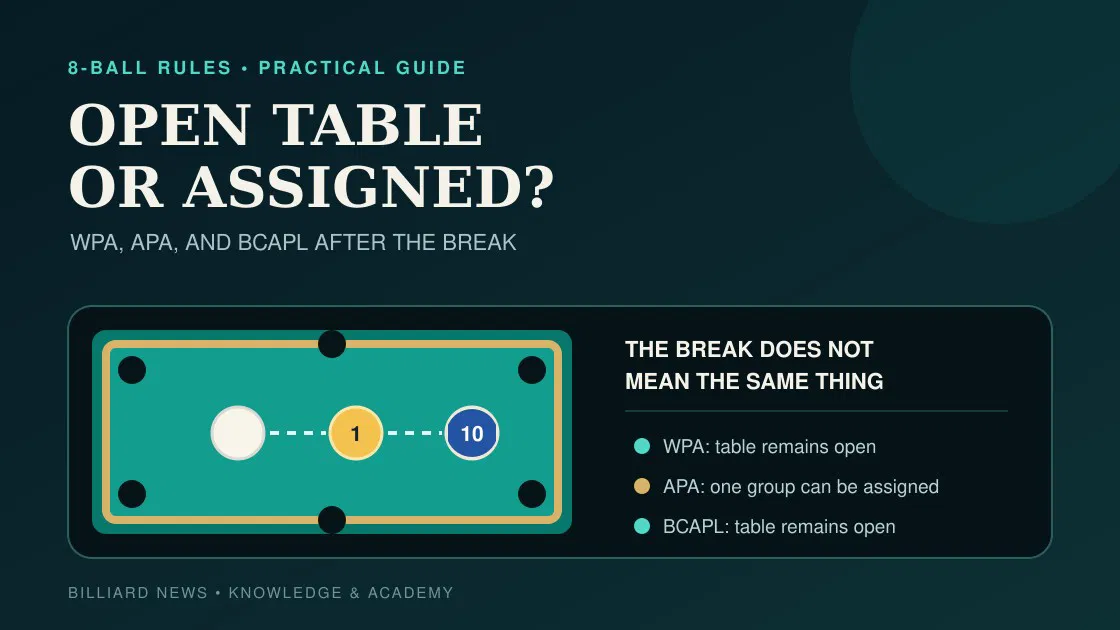
Pocketing a solid or stripe on the break does not assign the groups in every version of 8-ball. Under WPA and CSI/BCAPL rules, the table remains open after a legal break. Under APA rules, pocketing balls from only one category gives the breaker that category; pocketing both categories leaves the table open.
That difference matters because a player who assumes the wrong rule can plan the wrong pattern—or even give away ball in hand by contacting the wrong group first.
What does “open table” mean?
An open table means neither player owns solids or stripes yet. While the table is open, a player may contact any solid or stripe first and can use a cross-group combination. The 8-ball is the exception: it cannot be the first ball contacted in an open-table combination.
Under WPA and CSI rules, groups become assigned only when a player legally pockets a called ball after the break. If the shot fails, the table stays open for the next player.
How do WPA, APA, and BCAPL compare?
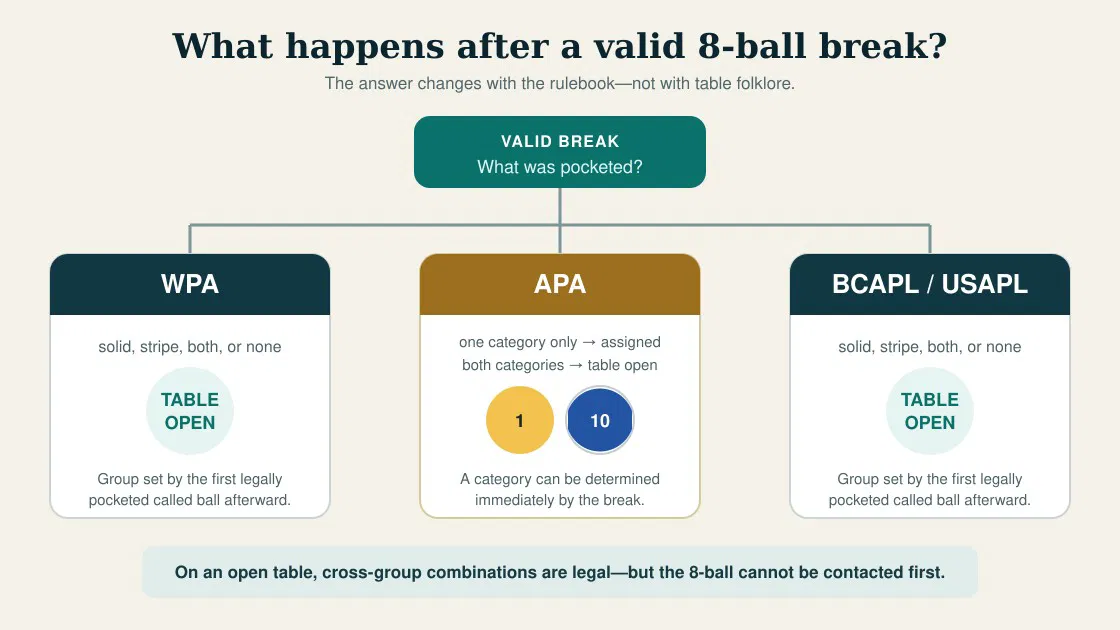
| Break result | WPA | APA | BCAPL / USAPL |
|---|---|---|---|
| One solid pocketed | Table open | Solids assigned to breaker | Table open |
| One stripe pocketed | Table open | Stripes assigned to breaker | Table open |
| Both groups pocketed | Table open | Table open | Table open |
| No object ball pocketed | Table open; turn ends | Table open; turn ends | Table open; turn ends |
| Open-table combination | Legal across groups; 8-ball cannot be first | Legal across groups; 8-ball cannot be first | Legal across groups; 8-ball cannot be first |
| Groups are determined | First legally pocketed called ball after the break | On the break if only one category falls; otherwise by the next legal group-making shot | First legally pocketed called ball after the break |
The table compares a valid break under the standard versions of each ruleset. Local tournament directors can publish modifications, so confirm the event sheet before play begins.
What happens under WPA rules?
WPA Rule 4.3 says the breaker continues if any ball is pocketed on a legal break, but the table remains open. Rule 4.4 then establishes a group when a player legally pockets the called ball on the next or a later shot.
That creates a useful strategic window. The breaker is not forced to accept solids simply because a solid fell. They can inspect both groups, choose the cleaner pattern and call a stripe if stripes offer the better route.
What happens under APA rules?
APA treats the break differently. If balls from only one category are pocketed on a legal break, that category becomes the breaker’s group. If at least one solid and one stripe are pocketed, the table remains open.
This means the break can decide the category before the player has evaluated the full layout. APA players should therefore know their group before addressing the next shot rather than relying on WPA or BCAPL habits.
What happens under BCAPL and USAPL rules?
CSI’s official rules, used by BCAPL and USAPL, state that the table is always open after the break. Solids and stripes are then assigned by the first legally pocketed called ball after the break.
On that open table, every object ball except the 8-ball is a legal first contact. A solid-to-stripe or stripe-to-solid combination is therefore legal, provided the called ball and pocket requirements are met.
How should you choose a group on an open table?
Do not choose solely because one easy ball is hanging near a pocket. Scan the whole rack and compare five factors:
- Immediate access: Which group offers a high-percentage opening shot?
- Problem balls: Which group has fewer clusters, blocked pockets or rail-bound balls?
- The key ball: Which group leaves a natural final ball to reach the 8-ball?
- Opponent blockers: Can one of your balls clear a lane or occupy a valuable pocket?
- Insurance: After the first shot, will another makeable ball remain if position is imperfect?
A slightly harder first shot can be the correct choice if it leads to a simple, connected pattern. A hanging ball is attractive, but it can also be the only useful key ball for later.
What is the safest pre-match rule check?
Ask one exact question: “Is the table open after every legal break, or can the break assign a group?” That wording resolves the biggest WPA–APA difference immediately. Also confirm whether the event uses call-shot, call-pocket or local league conventions.
Knowing the rule is not just about avoiding a foul. It determines whether you are selecting from fourteen possible object balls or already committed to seven.
If I make one solid and one stripe on an APA break, which group am I?
The table remains open. Your next legal shot can determine the group.
If I make only a solid on a WPA break, am I solids?
No. The table remains open until a player legally pockets a called ball after the break.
Can I play a solid into a stripe while the table is open?
Yes under these rulesets, provided the 8-ball is not the first ball contacted and all call-shot requirements are satisfied.
Does BCAPL use the same after-break rule as WPA?
For group assignment, yes: the table remains open after the break, and the first legally pocketed called ball establishes the group.