Is a Hanging Ball Pocketed? WPA's Five-Second Rule
A practical guide to WPA Rules 2.2 and 1.8, covering hanging balls, late drops, supported balls, rebounds, restoration, and replayed shots.
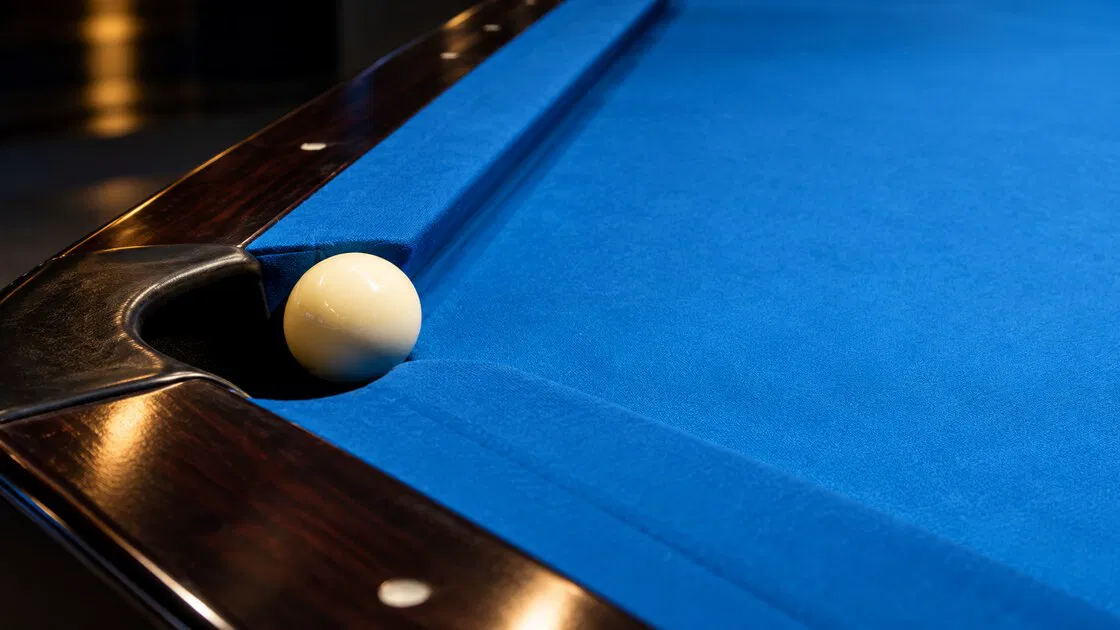
A ball balanced in the jaws of a pocket is not automatically pocketed. Under the current World Pool Association Rules of Play, play pauses for five seconds after the shot is over. If the ball falls during that window, it counts as pocketed; if it remains apparently motionless for five seconds and falls later by itself, it is restored and does not count.
That answer applies to WPA rules. APA, BCAPL, USAPL, a local league, or a bar tournament may use a different rulebook or procedure, so always confirm the rules named by the event.
When Is a Ball Officially Pocketed Under WPA Rules?
WPA Rule 2.2 gives a physical definition. A ball is pocketed when it comes to rest in a pocket below the playing surface or enters the ball-return system.
That means appearance alone is not decisive. A ball can sit deep in the jaws and look certain to fall, but if it is still supported at the edge of the playing surface, the referee must apply the hanging-ball procedure.
The current WPA Rules of Play are marked effective October 21, 2026. The two controlling provisions are Rule 2.2, Ball Pocketed, and Rule 1.8, Balls Settling.
When Does the Five-Second Count Start?
The count starts after the shot is over, not when the cue tip contacts the cue ball and not when the object ball first reaches the pocket.
WPA Rule 2.19 says a shot ends when all balls in play have stopped moving and spinning. Once that condition is met and a ball is apparently motionless near the edge of a pocket, play is suspended for five seconds.
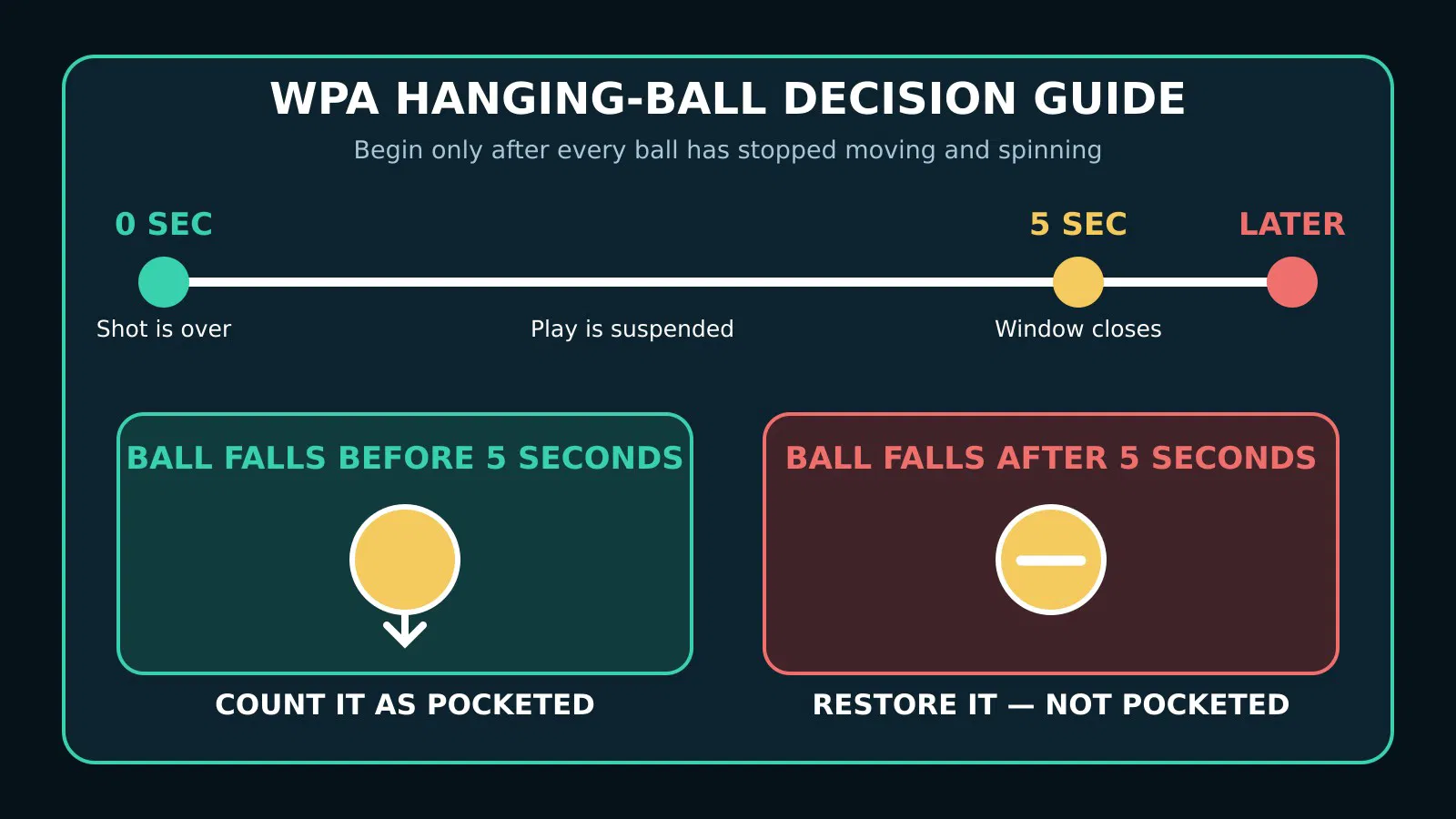
Start the five-second window only after the shot has ended. A late fall after a full five seconds is restored rather than scored.
A practical sequence is:
- Wait until every ball has stopped moving and spinning.
- Suspend play while the hanging ball is observed for five seconds.
- If it falls before five seconds expire, treat it as pocketed.
- If it remains apparently motionless for the full five seconds, resume play.
- If it then falls by itself, restore it as closely as possible to its prior position.
What Happens in the Most Common Situations?
| Situation | WPA ruling |
|---|---|
| Ball falls three seconds after the shot ends | Pocketed |
| Ball remains still for five seconds, then falls | Not pocketed; restore it |
| Ball settles slightly but stays on the table | Leave it where it settles |
| Ball falls just before or during the next shot and changes the result | Restore the position and replay the shot |
| Object ball enters a pocket and rebounds to the playing surface | Not pocketed |
| Cue ball contacts a ball already in a full pocket and rebounds | Cue ball is still treated as pocketed |
The five-second rule prevents an open-ended wait. A player cannot claim that a ball is still "about to drop" after it has remained motionless for the full window.
What If the Ball Falls During the Next Shot?
Rule 1.8 covers a ball that settles after it seemed to stop. If it falls into a pocket during or just before a later shot and that movement affects the shot, the referee restores the position and the shot is replayed. The shooter is not penalized simply for shooting while the ball was settling.
For example, suppose the 3-ball is hanging in a corner pocket. The incoming player begins a stroke at the 4-ball, the 3-ball suddenly drops, and the cue ball travels through the space the 3-ball had occupied. Because the late fall changed the shot, the table is restored as well as possible and the shot is replayed.
If the settling ball falls but has no effect on the next shot, the ball is restored and play continues. In a refereed match, placement is a judgment call under Rule 1.9.
What If Two Balls Are Jammed in the Pocket Jaws?
WPA uses a supporting-ball test. A ball hanging over the edge is treated as pocketed when another ball partly supports it and removing that supporting ball would cause the hanging ball to fall.
This can happen when:
- two balls become jammed together in the jaws;
- pocketed balls fill the pocket and support another ball at the edge; or
- the upper ball cannot remain in place without the lower ball.
The supported ball is removed and handled as if it had been pocketed under the rules of the game being played. Do not lift a ball yourself to perform the test in a match. Ask the referee or tournament director to rule on the position.
Does a Ball That Bounces Back Out Count?
An object ball that rebounds from a pocket onto the playing surface is not pocketed. It must remain down according to the definition in Rule 2.2.
The cue ball has a special warning: if it contacts a ball already in a pocket and rebounds onto the table, WPA still treats the cue ball as pocketed. The shooter is responsible for making sure a full or nearly full pocket is cleared before playing a shot toward it.
How Should Players Handle This Without a Table Referee?
Use a neutral, repeatable procedure before either player takes the next shot.
- Stop the incoming player from addressing the cue ball.
- Agree that the previous shot has ended.
- Count five seconds without touching the table, rail, or balls.
- If the ball falls late, mark or agree on the closest prior position before restoring it.
- If the fall affects a shot already in progress, stop and call the tournament director.
- Check the event rulebook before assuming WPA procedure governs the match.
In an unrefereed match, restoration will often be an estimate. Both players should agree on placement before play resumes. If they cannot, the tournament director should decide.
Does the Rule Apply the Same Way in Every U.S. League?
No. The rule explained here is the WPA rule.
APA publishes its own Official Team Manual and Game Rules. CueSports International publishes the rules used by BCAPL and USAPL on its BCA Pool League Rules page. Local bylaws and event instructions may add another layer.
| Competition notice says | First document to check |
|---|---|
| WPA Rules of Play | Current WPA PDF plus event regulations |
| APA | Current APA manual and local bylaws |
| BCAPL or USAPL | Current CSI rules and event instructions |
| House rules | Written rules supplied by the room or director |
A late-dropping 8-ball can decide a rack, so the governing rule set must be identified before declaring a win or loss.
What Mistakes Cause Unnecessary Arguments?
- Starting the five seconds when the cue tip hits the cue ball.
- Assuming a ball deep in the jaws is already pocketed.
- Waiting indefinitely after five seconds have elapsed.
- Touching the ball or pocket to see whether the ball will fall.
- Continuing with the next shot before the observation period ends.
- Treating a rebounding object ball as pocketed.
- Applying WPA language automatically to APA, CSI, or house rules.
- Making a ruling from a social-media comment instead of the event rulebook.
What Is the Fastest Ruling Checklist?
Ask three questions:
- Did the ball come to rest below the playing surface or enter the return system?
- If it was hanging, did it fall before or after five seconds following the end of the shot?
- Did a late fall affect a subsequent shot?
Those answers separate a scored ball, a restored ball, and a replayed shot without relying on how certain the ball looked to fall.
Frequently Asked Questions
Is a ball hanging in the pocket already pocketed?
Not necessarily. Under WPA rules it must rest below the playing surface, enter the return system, or satisfy the supporting-ball test.
What if the ball falls within five seconds?
If it falls during the five-second observation period after the shot ends, it is treated as pocketed.
What if it falls after five seconds?
It is not pocketed merely because it falls later by itself. Restore it as closely as possible to its prior position.
Does the count start at cue-ball contact?
No. The count begins after the shot is over, when all balls in play have stopped moving and spinning.
What if a late fall changes the next shot?
Restore the position and replay the shot. The shooter is not penalized solely for shooting while a ball was settling.
Is this automatically the APA or BCAPL rule?
No. This article explains WPA procedure. Use the league or tournament rulebook named for the match.