10-Ball Explained: Rules, Format and Why It Took Over Pro Pool
Every shot is called and the money ball cannot drop on the break — what viewers in Doha are actually watching this week.
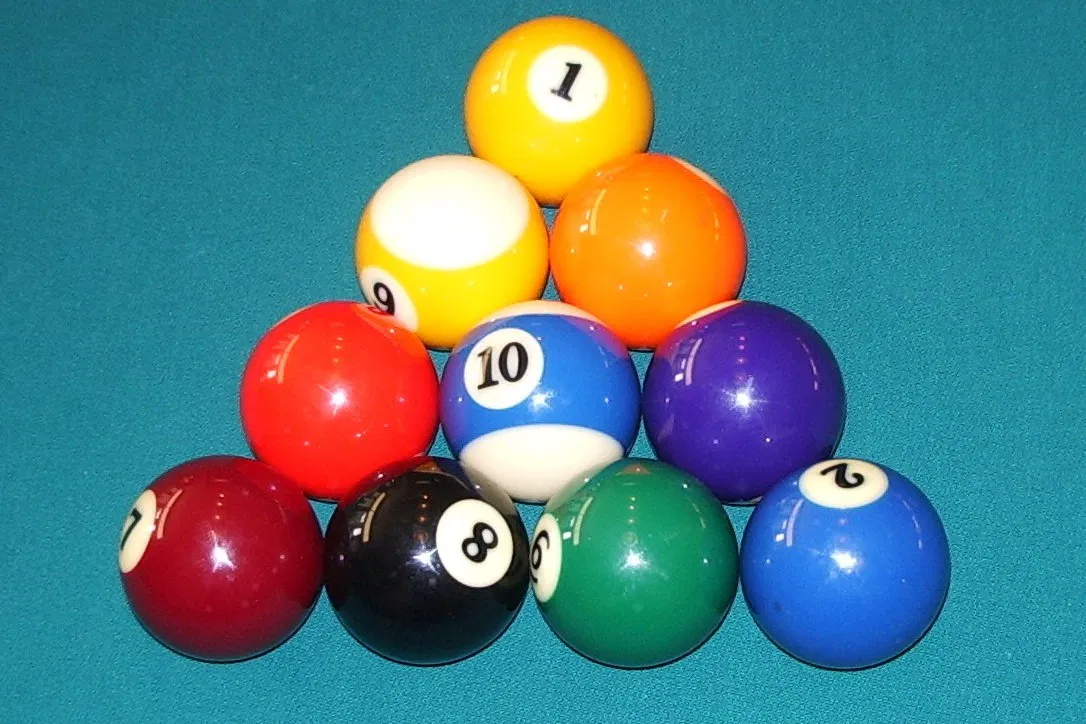
The richest week on the 10-ball calendar is playing out in Doha right now. The Qatar World Cup 10-Ball — $450,000 on the table, 128 players at the Ezdan Palace Hotel, a champion crowned October 29 — is being contested in a discipline plenty of casual fans have heard of but never actually watched: call-shot ten-ball.
If your pool vocabulary stops at nine-ball, here is the game the professionals are playing this week, why the World Pool Association built its championship calendar around it, and the handful of rules that decide who takes home the $100,000 top prize.
What Is 10-Ball?
Ten-ball is a rotation game played with ten object balls numbered 1 through 10. The balls are racked in a triangle — the 1-ball at the apex on the foot spot, the 10-ball in the middle — and the cue ball must always contact the lowest-numbered ball on the table first.
You win by legally pocketing the 10-ball. Two rule choices separate it from nine-ball: every shot after the break must be called, and the money ball cannot win early. There are no lucky 10-balls — not on the break, not on a fluke, not on an early combination.
Why Did the WPA Choose 10-Ball?
Ten-ball exists because nine-ball started breaking at the professional level. Once players learned to exploit tightly frozen racks — a controlled soft break sending the wing ball to the corner and leaving the 1-ball near a side pocket — elite racks became repetitive, and break-and-run packages piled up. Organizers tried break rules and racking tweaks, but the structural problem stayed: nine-ball rewarded execution that had largely been solved.
Ten-ball was standardized to strip that luck out. One more ball crowds the rack and makes balls harder to pocket on the break. Call-shot removes slop entirely — a ball that drops in the wrong pocket simply ends the inning. And because the 10 can only win when it is the last ball standing, every rack has to be fully earned.
The WPA has staged a World Ten-ball Championship since 2008, when Darren Appleton beat Wu Jia-qing in Manila for $100,000, and its modern championship circuit — the World 10-Ball Championship and big-money opens like this week's Qatar World Cup — runs on the discipline. Matchroom's World Nineball Tour still plays nine-ball for its flagship events, so professional pool now splits between a televised nine-ball circuit and the WPA's call-shot championship game. If you want the longer version of how the games compare, we broke down eight-ball, nine-ball and ten-ball earlier this season.
How Is 10-Ball Different From 9-Ball?
| Nine-ball | Ten-ball | |
|---|---|---|
| Rack | Diamond, 9 in the middle | Triangle, 10 in the middle |
| Money ball on the break | Wins the rack | Spotted — play continues |
| Pocketing | Slop counts | Ball and pocket must be called |
| Early combos | A carom on the 9 can win anytime | The 10 made early is spotted |
| Extra balls on a shot | All count | Only the called ball counts |
The practical result is a harder, longer game — which is precisely why promoters like the Qatar Billiards Sports Federation ask for it when a world title is on the line.
The Rules That Decide Racks in Doha
The break
The breaker starts with the cue ball behind the head string and must hit the 1-ball first. For a legal break, a ball must be pocketed or at least four object balls must reach a cushion — otherwise it is a foul and the opponent gets ball in hand. A 10-ball pocketed on the break is spotted and the breaker plays on. There is no golden break in ten-ball.
Call shot
On every shot after the break, the shooter designates the ball and the pocket. Kisses, caroms and combinations do not need to be described — only which ball and which hole. Make the called ball in the called pocket and you continue; pocket it anywhere else, or pocket the wrong ball, and the inning ends without a foul, the balls staying down. The exception is the 10: pocketed out of turn, it always comes back up on the spot.
The called safety
A shooter may declare “safety” before a shot. A legally pocketed ball on a called safety still ends the inning — a tactical escape hatch that produces some of the most interesting sequences in tournament play.
The push-out
The shot immediately after a legal break may be played as a push-out — the cue ball can go anywhere without hitting the lowest ball or a rail. The opponent then chooses whether to shoot or hand the shot back. We covered push-out strategy in detail earlier; the same logic applies here.
Fouls and the three-foul rule
Any foul gives the opponent cue ball in hand anywhere on the table. Three consecutive fouls by the same player lose the rack — the referee must warn the player after the second. In a race to 9 or 11, one foul-heavy rack is often the whole match.
The Tournament Format in Doha
The main event opened October 24 with 128 players in a double-elimination bracket racing to 9 — lose twice and you are out, which is how names like Joshua Filler and Albin Ouschan hit trouble early. Winners' and losers' qualification rounds feed a last-64 single-elimination bracket played at race to 11, building to a race-to-13 final on October 29. The champion collects $100,000; the runner-up $40,000; every player reaching the knockout is guaranteed at least $3,000.
Reigning world 10-ball champion Wojciech Szewczyk — already beaten once by Filipino qualifier Aivhan Maluto — is fighting through the losers' side, while defending champion Jonas Magpantay is through to the last 64 unscathed. Follow the bracket in our day-by-day coverage.
Can you win a game of 10-ball on the break?
No. A 10-ball pocketed on the break is spotted and play continues — the money ball only wins when it is the legal ball on.
Do lucky or fluked balls count in 10-ball?
No. Every shot must be called — ball and pocket. A ball that drops uncalled or in the wrong pocket ends the inning but is not a foul.
Is there a push-out in 10-ball?
Yes. The shot right after a legal break may be played as a push-out, and the opponent chooses whether to take the shot or give it back.
What happens on a foul?
The incoming player gets cue ball in hand anywhere on the table. Three consecutive fouls lose the rack.
Where can I read the full rules?
Ten-ball is Section 6 of the WPA Rules of Play. For a fan-friendly walkthrough, pool4.org keeps a plain-English 10-ball rules rundown.
Rules references: WPA Rules of Play. Event details via the Qatar Billiards Sports Federation's official invitation and WPA event coverage.