9-Ball Push-Out Strategy: When to Use It and What to Leave
A rule-by-rule guide to the 9-ball push-out, plus a decision framework and 15-position drill for making the opponent choose.

A 9-ball push-out is legal only as the first shot after a legal break in rule sets that allow it. Announce it before shooting, move the cue ball to a position that creates a difficult choice, and remember that your opponent may accept the table or make you shoot again. The best push-out is not simply an escape—it leaves a shot you are prepared to play but your opponent may not want.
What Is a Push-Out in 9-Ball?
A push-out is a special post-break shot. It temporarily suspends two normal 9-ball requirements: the cue ball does not have to contact the lowest-numbered ball first, and no ball has to reach a rail after contact. The cue ball may contact no object ball at all.
That freedom is narrow. Scratching, touching a moving ball, double-hitting the cue ball, striking a push shot, or committing another ordinary foul is still penalized. A push-out is a legal tactical option; it is not permission to ignore every rule.
After a legal push-out, the incoming player chooses between two options:
- Shoot from the new position.
- Return the shot to the player who pushed out.
This choice is the center of the strategy. If you leave an easy shot, the opponent accepts it. If you leave an impossible shot, the opponent gives it back. A strong push-out sits between those extremes.
When Do WPA Rules Allow a Push-Out?
Under the current WPA Rules of Play, effective September 15, 2025, the player taking the first shot after a legal 9-ball break may elect to push out. The intention must be announced before the stroke.
The option belongs to whoever owns that first post-break shot. If the breaker legally pockets a ball and continues, the breaker may push. If no ball is made and the inning passes, the incoming player may push. It is not available later in the rack.
If the 9-ball is pocketed during a WPA push-out, it is spotted. Other object balls remain pocketed. The opponent then accepts the position or passes it back, provided the shot contained no foul.
Tournament conditions can modify a general rule set, so confirm the posted event rules before the match.
How Do CSI, APA, and WPA Push-Out Rules Compare?
The basic choice is similar under WPA and CueSports International rules, but U.S. league players must pay attention to the format. APA handicapped play does not use the push-out, while APA Masters does.
| Rule set or format | Push-out allowed? | Announcement | Balls pocketed on push-out | Opponent may pass back? |
|---|---|---|---|---|
| WPA 9-ball | Yes, first shot after a legal break | Announce before the shot | 9-ball spotted; other balls stay down | Yes |
| CSI / BCAPL / USAPL 9-ball | Yes, first shot after a break with no foul | Tell opponent; opponent acknowledges | 9-ball spotted; other balls stay down | Yes |
| APA handicapped 9-ball | No | Not applicable | Not applicable | Not applicable |
| APA Masters | Yes, immediately after the break | Announce before the shot | Every pocketed ball is spotted | Yes |
CSI's Official Rules of CueSports International, used by BCAPL and USAPL, state that a push-out is available after a break without a foul. The shooter is not required to contact the lowest ball or any object ball, and no ball must contact a cushion. All other rules and fouls still apply.
APA's After the Break guidance explicitly says push-outs are not allowed in handicapped competition. The APA Masters Championship rules allow them, but any ball pocketed on the shot is spotted. That ball-handling difference can change the correct decision.
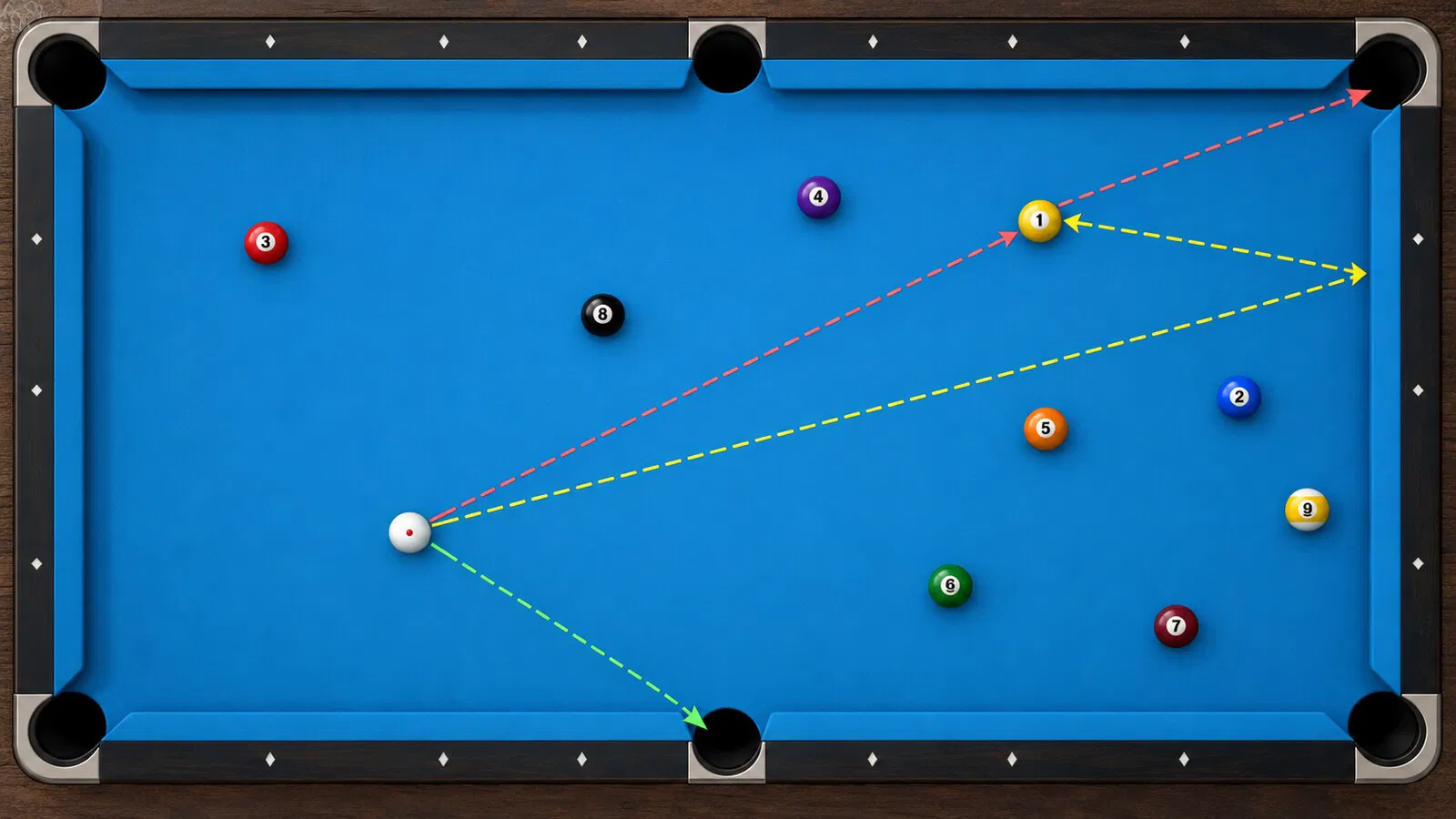
A push-out can offer a long cut, a bank, or a safety-oriented position. The best route depends on what happens if the opponent accepts or returns the shot.
Is a Push-Out the Same as a Push Shot?
No. The similar names describe completely different things.
| Term | Meaning | Legal status |
|---|---|---|
| Push-out | A declared tactical option immediately after the break | Legal when the applicable 9-ball rules allow it |
| Push shot | The cue tip maintains contact with the cue ball longer than a normal stroke | A foul |
| Double hit | The cue tip contacts the cue ball more than once | A foul |
The distinction matters most when the cue ball finishes very close to the 1-ball. Declaring a push-out does not legalize a prolonged tip contact or a double hit. Use a clean stroke and ask for a referee or neutral observer if the balls are close enough to create doubt. Dr. Dave's push-shot foul resource provides visual examples of the mechanics involved.
What Is the Strategic Goal of a Push-Out?
The goal is to create a decision that is uncomfortable for the opponent and manageable for you.
Imagine every possible position on a scale. At one end is a routine shot that any competent opponent will accept. At the other is a nearly hopeless shot that will always be returned. The useful zone is in the middle: difficult enough to make acceptance risky, yet playable enough that you can respond if it comes back.
A good position often has four characteristics:
- It matches one of your strengths better than the opponent's.
- A miss does not automatically sell out the rack.
- A controlled safety is available if the shot is returned.
- The lowest-numbered ball is not hanging near a pocket.
The push-out is therefore partly a player-comparison problem. The same long bank can be excellent against one opponent and terrible against another. Table position alone does not determine the answer.
How Should You Make the Decision in 20 Seconds?
Use this sequence before moving the cue ball:
- Check the normal options. Is there a high-percentage offensive shot, containing safety, or controlled kick? Do not push out simply because the first shot looks awkward.
- Identify the opponent's likely choice. For each new cue-ball position, ask whether the opponent would accept it or send it back.
- Plan the returned shot. Name the exact shot you will play if the opponent passes. If you cannot name one, the push-out plan is incomplete.
- Compare skills. Consider long cuts, banks, jumps, kicks, speed control, and safety play—not just general ability.
- Check accidental rewards. Avoid opening a combination on the 9, moving the lowest ball near a pocket, or leaving a simple lock-up safety.
- Confirm the rule set and announce. A sound tactical idea can still become a foul or an illegal option under the wrong format.
This process is fast once practiced. The key question is never only, “Where can I move the cue ball?” It is, “What decision will this position force, and what will I do next?”
Which Push-Out Positions Work Most Often?
A long, thin cut
Moving the cue ball to expose the 1-ball while leaving a long thin cut can be effective when the object ball is away from a pocket. The opponent must balance pocketing percentage against cue-ball control and the risk of selling out.
Before choosing it, trace the natural cue-ball route. A difficult pot can still be attractive if the cue ball naturally reaches the next ball or if a miss tends to leave distance.
A controlled one-rail bank
A bank can create the desired “take it or give it back” decision because pocketing and position are both uncertain. It works best when a miss does not leave the object ball over a pocket.
Avoid this option against a player whose bank speed is clearly stronger than yours. You are allowed to choose the exam; do not select the opponent's favorite subject.
A jump or kick with positional risk
Sometimes a push-out exposes only a jump or kick. Evaluate more than the probability of contact. A player may jump accurately but have limited control of the cue ball after impact. That uncertainty can make the shot unattractive.
Equipment and event rules matter. Some rooms restrict jump cues, and some amateur formats handle jump shots differently. Verify before building the strategy around one.
A close-range, awkward bridge
Placing the cue ball near the lowest ball can make a cut or safety delicate. The short bridge, elevated cue, and double-hit risk may discourage the opponent.
This position is dangerous if the balls line up for an easy containing safety. Test both sides of the choice before committing.
What Does a Good Push-Out Look Like in a Real Rack?
Suppose a legal break leaves the cue ball fully hidden from the 1-ball. The 1-ball is near center table, not close to a pocket. A direct kick has a high chance of giving ball in hand.
You identify two push-out positions:
- Position A leaves a long thin cut to a corner.
- Position B leaves a one-rail bank.
Your opponent banks confidently but struggles with long cuts and cue-ball speed from distance. Position A is the better candidate—but only if you have a response when it is returned. Your plan might be to play a thin safety that sends the 1-ball up-table and keeps the cue ball behind traffic.
If the opponent accepts, they face a low-percentage shot. If they return it, you execute a safety you already selected. That is a complete push-out plan. Merely moving the cue ball into open space is not.
How Can You Practice Push-Out Strategy?
Use a 15-position decision drill. It trains judgment rather than pure execution.
Setup
Create five post-break layouts in which the cue ball has no comfortable direct shot on the lowest ball. For each layout, mark or photograph three possible push-out destinations. A practice partner acts as the opponent and chooses to accept or return each position.
Play all 15 decisions, then switch roles.
Scoring
| Outcome after the choice | Score |
|---|---|
| You gain the first controlled attack or strong safety | 2 |
| Position remains approximately neutral | 1 |
| Opponent receives a high-percentage attack | 0 |
| Your push-out contains a foul | -1 |
Do not score only the final rack result. A lucky miss can hide a poor decision, while a well-designed push-out can still lose. Grade the quality of the forced choice and whether your prediction was correct.
After each set, record two facts: which positions the partner accepted, and which returned shots you executed successfully. Over time, the log shows whether your weakness is prediction, shot selection, or execution.
What Push-Out Mistakes Cost the Most Racks?
- Using a push-out in APA handicapped play, where it is not permitted.
- Failing to announce clearly before the stroke.
- Assuming the declaration cancels ordinary fouls.
- Moving the cue ball without planning for a returned shot.
- Leaving the lowest ball near a pocket or opening an easy combination.
- Giving a specialist the exact bank, jump, or kick they prefer.
- Hitting too hard and changing several balls unnecessarily.
- Pocketing a ball without knowing whether the format spots it.
- Judging the position only by shot difficulty and ignoring safety options.
Frequently Asked Questions
Can I push out after any 9-ball break?
Only after a legal break, and only if the governing rules allow the option. A foul on the break removes the push-out under WPA and CSI rules because the incoming player receives the applicable foul remedy instead.
Must the cue ball contact the 1-ball on a push-out?
No. Under WPA and CSI, it does not have to contact the lowest-numbered ball or any object ball, and no ball must reach a rail. Other fouls still apply.
Who shoots after a push-out?
The opponent chooses. They may shoot from the new position or require the player who pushed out to shoot again.
What happens if the 9-ball drops?
WPA, CSI, and APA Masters spot the 9-ball. Under WPA and CSI, other pocketed object balls stay down; APA Masters spots every ball pocketed during the push-out.
Is push-out allowed in regular APA 9-ball?
No. APA's handicapped competition does not allow it. APA Masters and the U.S. Amateur format do.
Can a push-out still be a foul?
Yes. A scratch, double hit, push shot, ball moved by the player, or another ordinary foul is still penalized.