Why One-Rail Bank Shots Miss—and How to Calibrate Them
A practical guide to mirror-system geometry, real-table corrections, and a repeatable 30-shot drill for one-rail banks.
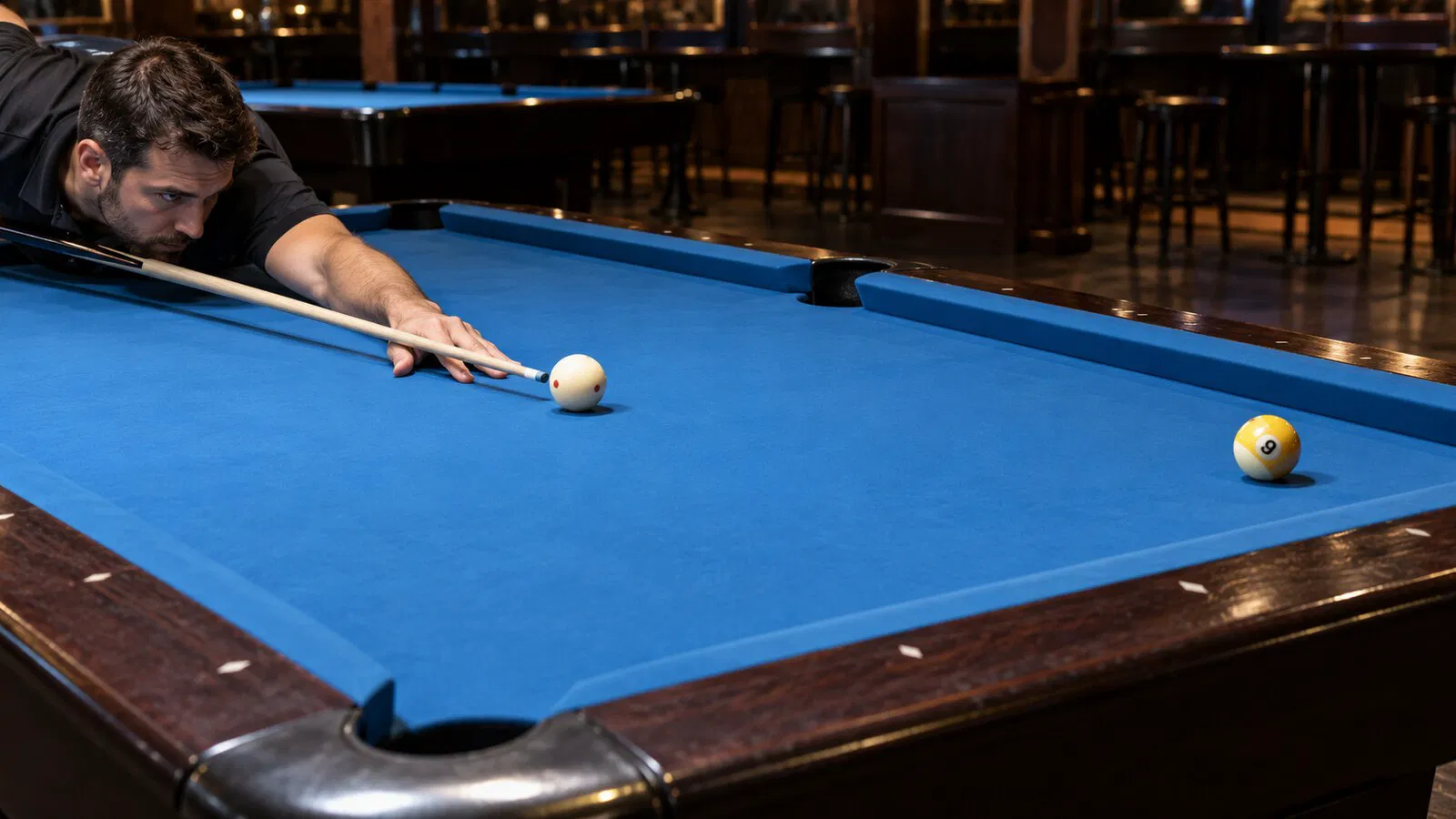
The mirror system gives a useful geometric starting point for a one-rail bank, but it does not guarantee the make. Real balls interact with cloth and cushions: speed changes how much the object ball rolls before impact, cut angle creates transferred spin, and each table rebounds differently. Reliable banking comes from combining the mirror line with a repeatable speed and a small, measured table adjustment.
What Is a One-Rail Bank Shot?
A bank shot sends an object ball to a cushion before it enters the intended pocket. A kick shot sends the cue ball to a cushion before it contacts the object ball.
The distinction matters because the ball reaching the cushion is different. On a bank, the object ball's roll and transferred spin control the rebound. On a kick, the cue ball's own follow, draw, and sidespin are direct variables.
Players often use the same geometric systems for both, but the corrections are not identical. This guide focuses on a one-rail object-ball bank.
How Does the Mirror System Find the Baseline Aim?
Imagine the target pocket reflected to an equal distance beyond the banking cushion, as if the rail were a mirror. Draw a straight visual line from the object ball to that virtual pocket. Where the line crosses the cushion is the baseline bank point.
Dr. Dave describes the mirror system as a visual application of the classic 2-to-1 geometry. For banks, the pocket is the target and the measurement begins at the object ball. The equal-distance system and midpoint parallel-shift method locate the same theoretical point in different ways.
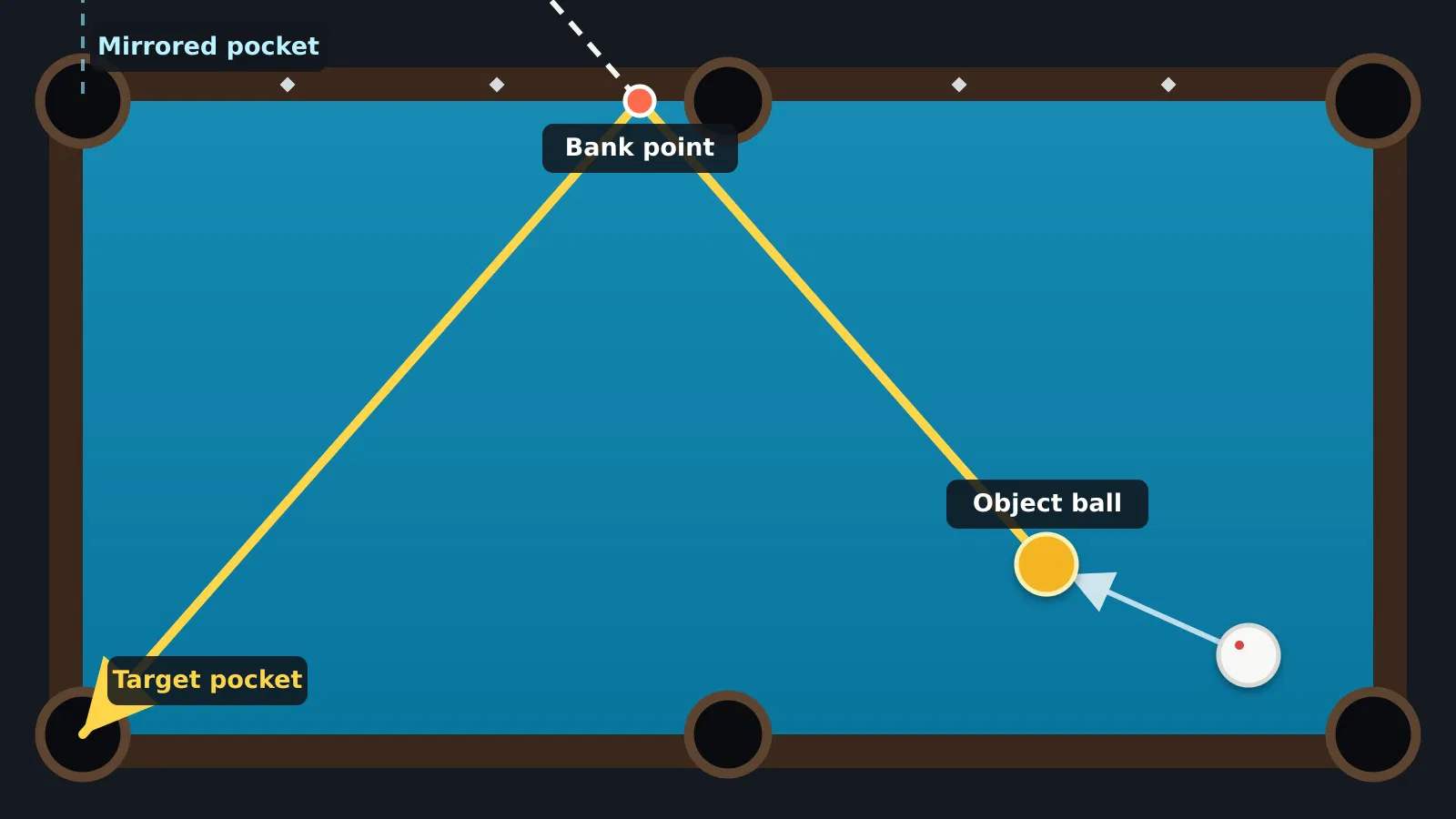
The straight sight line to the mirrored pocket identifies a geometric cushion point. The yellow path is the corresponding equal-angle baseline to the real pocket.
The word baseline is essential. Equal-angle geometry assumes an ideal reflection. A pool cushion is not a perfect mirror, and a rolling sphere is not a ray of light.
Why Does an Equal-Angle Bank Still Miss?
Four families of effects move the object ball away from the theoretical line.
Speed and forward roll
An object ball struck softly has more time to develop forward roll before it reaches the cushion. The roll and cloth friction influence the path after rebound. A firmer bank often reaches the cushion with less forward roll and can play shorter, but cushion response and approach angle also matter.
Treat “harder goes short” as a common working tendency, not a universal law. The useful rule is more practical: choose one speed, learn that speed on the current table, and change only one variable at a time.
Cut-induced and transferred spin
When the cue ball cuts the object ball, friction can transfer sidespin to the object ball. That spin changes how it grips the cushion. Dr. Dave's bank and kick effects summary notes that an outside cut tends to shorten a bank and an inside cut tends to lengthen it, unless gearing outside spin is used to reduce throw and spin transfer.
The cut also changes throw before the object ball even reaches the rail. Aiming the object ball at the geometric bank point is therefore only part of the shot.
Distance from ball to cushion
A ball close to the cushion has little time to change from sliding to rolling. A ball several feet away may arrive in a very different state, even if the visible angle is similar. Two layouts that share the same mirror point can require different corrections.
Table and ball conditions
Clean, polished balls, slick cloth, humidity, cushion liveliness, and rail construction all affect rebound. According to Dr. Dave's physics summary, banks generally play longer on clean balls and slick, dry equipment, while livelier cushions can make them play shorter. Those are trends, and interacting effects can produce exceptions.
This is why a system learned on a home table may miss by half a diamond on unfamiliar equipment.
Which Variables Should You Control First?
For a useful calibration, stabilize the variables you can control.
| Variable | First-practice choice | Why it helps |
|---|---|---|
| Cue-ball spin | Center ball | Reduces intentional spin transfer variables |
| Shot speed | Medium-firm | Easier to reproduce than a soft roll or power stroke |
| Object-ball position | Fixed spot | Makes misses comparable |
| Target pocket | Same pocket | Keeps geometry constant |
| Cut direction | Same side | Prevents opposite spin-transfer effects from mixing |
| Result record | Pocket, short, or long | Converts feel into an adjustment |
“Center ball” does not mean the object ball receives no spin. Cut-induced spin can still occur. It means you are not adding another intentional sidespin variable while building the baseline.
How Do You Aim and Execute the Shot?
Step 1: Choose the pocket and banking rail
Confirm that a one-rail bank is actually the percentage choice. Check for double-kiss risk, blockers, scratch paths, and whether a safety is stronger.
Step 2: Build the mirror line
Visualize the target pocket the same distance beyond the cushion. Sight from the object ball through the cushion toward that virtual pocket. Mark the crossing point mentally using the diamonds, rail sights, or a nearby reference.
Use the cushion nose or the consistent reference recommended by the system—not a random point on top of the wooden rail.
Step 3: Select one speed before getting down
Decide on soft, medium, or firm speed while standing. Changing speed during the final stroke changes the bank correction and usually damages delivery.
Medium-firm is a productive practice baseline. It reduces the large roll variation of very soft shots without demanding a power stroke.
Step 4: Set the cut and cue-ball route
The bank must be pocketed, but the cue ball must also survive the shot. Trace the tangent and follow paths for scratches or collisions. If a thin cut is required, expect more cut-induced effects than on a near-full hit.
Step 5: Apply the table correction
Your test shots may show that the table plays short or long relative to the mirror line. Move the object-ball target on the cushion by the measured amount. Keep the speed and cut as stable as possible.
Step 6: Deliver and diagnose
Finish the stroke without steering. Watch where the object ball reaches the pocket line, not only whether it falls. A miss on the near jaw and a miss on the far jaw require opposite corrections.
What Do “Short” and “Long” Mean on a Bank?
Players need a shared vocabulary to use feedback.
For a bank aimed to a corner, a short rebound turns more sharply off the cushion and reaches the pocket line sooner. A long rebound opens wider and travels farther down-table before reaching that line.
Because table orientation changes, “left” and “right” are poor diagnostic words. Record short or long relative to the intended pocket path.
| Result | Likely interpretation | First adjustment to test |
|---|---|---|
| Repeatedly short | Table/shot combination rebounds tighter than baseline | Aim slightly farther down the banking rail |
| Repeatedly long | Rebound opens beyond baseline | Aim slightly closer to the target-pocket side |
| Alternates short and long | Delivery or speed is inconsistent | Stabilize stroke before changing aim |
| Correct line, low pocket rate | Speed or pocket-entry angle varies | Narrow the speed window |
| Double kiss | Cue ball re-enters object-ball path | Change cut, speed, or choose another shot |
Make small corrections. One-eighth to one-quarter diamond is enough for the next test. Large guesses prevent you from learning what caused the change.
How Can You Read an Unfamiliar Table Quickly?
Do not wait for a match-winning bank to discover the rails. During legal warm-up time, use three reference tests.
- A near-straight cross-side bank. This exposes the basic cushion response with limited cut.
- A medium-angle corner bank. This adds distance and a realistic pocket-entry angle.
- The same bank at two speeds. Compare medium and firm while keeping the line constant.
Record only the direction and approximate size of the miss. For example: “medium corner bank: one-quarter diamond short.” That note is more useful than “rails are weird.”
Also inspect ball cleanliness, cloth speed, humidity, and obvious cushion inconsistencies. Dr. Dave's table-testing guidance emphasizes checking the specific equipment rather than assuming every table follows the same correction.
What Is a Good 30-Shot Bank Drill?
This drill produces a personal table map in about 20 minutes. Use a removable reinforcement ring, chalk mark permitted by the room, or a photo to reset the object ball. Do not mark tournament cloth without permission.
Block 1: Establish the baseline—10 shots
Place the object ball for a comfortable one-rail bank to a corner. Use center-ball cueing and medium-firm speed. Aim with the mirror system and shoot ten times.
Code every attempt:
- M — made.
- S — missed short.
- L — missed long.
- A — aim/alignment error you clearly felt.
- D — delivery or speed error.
- C — collision problem, including a double kiss.
Do not adjust after every single miss. Look for a pattern across the first five shots, make one small correction, then complete the block.
Block 2: Add cut angle—10 shots
Move the cue ball to create a thinner cut while preserving the same object-ball bank. Keep the selected speed. This block reveals how cut-induced spin and throw change your line.
Compare the short/long distribution with Block 1. If the result shifts consistently, save that difference as a cut-angle correction rather than blaming random aim.
Block 3: Test speed—7 measured shots
Return to the original cut. Shoot three balls at a softer controlled speed and four at a firm speed. The uneven split prevents a tidy but meaningless 50/50 score and forces you to identify which speed is more repeatable.
Record the path, not just makes. Seven misses that cluster at the same point may provide a stronger calibration than two lucky makes and five scattered misses.
Pressure finish—3 shots
Choose the speed and correction that produced the tightest pattern. Shoot three final attempts with a consequence: restart the three if you miss by more than one pocket width, or require two makes.
The full session contains 27 measured calibration shots and three pressure shots.
How Should You Score Progress?
Use two numbers:
- Make rate: made shots divided by total shots.
- Pattern rate: shots that finished within one pocket width of the correct line divided by total shots.
The pattern rate often improves before the make rate. That is meaningful progress because it shows the system and delivery are becoming predictable.
| Session | Makes / 30 | Within one pocket width | Main miss | Next focus |
|---|---|---|---|---|
| 1 | 8 | 17 | Long at soft speed | Keep medium-firm baseline |
| 2 | 11 | 22 | Short on thin cuts | Test smaller cut correction |
| 3 | 15 | 25 | Delivery errors | Pre-shot pause and finish |
Keep the object-ball position identical across sessions. Once the pattern rate is stable, move the ball one diamond and build a second reference bank.
What Common Banking Advice Should You Treat Carefully?
“The angle in always equals the angle out”
It is the geometric foundation, not the final prescription. Spin, roll, speed, and equipment move the result.
“Just hit every bank hard”
Firm speed can reduce some variables and is useful for many banks, but it also reduces pocket acceptance, increases cue-ball travel, and magnifies delivery errors. Select speed for the complete shot.
“Use English to fix the object ball”
Sidespin on the cue ball may transfer to the object ball, but the amount depends on cut, speed, friction, and contact quality. It is less predictable than a measured aim correction. Build a center-ball baseline first.
“Memorize one diamond system for every table”
Systems organize perception. They do not remove the need to test the equipment. The best system is a repeatable reference plus a written table correction.
How Should Different Skill Levels Practice?
- Newer players: Use one object-ball position, center ball, and one speed until misses form a pattern.
- Intermediate players: Add two cut angles and compare short/long tendencies.
- Advanced players: Map intentional speed and spin options while controlling cue-ball position.
- Coaches: Require the player to predict short, long, or make before every attempt, then explain the result.
Prediction turns practice from repetition into diagnosis. A player who can name the likely miss is beginning to understand the shot rather than hope for it.
Frequently Asked Questions
Is the mirror system accurate for every one-rail bank?
It supplies an equal-angle baseline. Real shots need adjustments for speed, roll, cut-induced spin, cushion response, cloth, and ball condition.
Should I aim at the diamond or the cushion nose?
Use the reference line defined by your chosen system consistently. The visible diamond is a coordinate marker; the ball contacts the cushion nose. Mixing reference lines creates avoidable error.
Does hitting harder always make a bank go short?
Often a firmer bank plays shorter because the object ball reaches the rail with less forward roll, but the result is not universal. Approach angle, cushion behavior, cloth, and spin effects interact. Test the table.
Should beginners use sidespin on bank shots?
Not for the first calibration. Start with center-ball cueing and a repeatable speed. Add intentional spin only after you can predict the baseline miss.
Why do I miss both short and long from the same position?
Scattered misses usually indicate inconsistent speed, tip placement, alignment, or stroke delivery. Stabilize those variables before changing the aiming system.
How many reference banks should I learn?
Begin with three: a cross-side bank, a medium corner bank, and a longer corner bank. Calibrate each at one standard speed, then learn how cut and speed alter them.
Sources
- Dr. Dave: Bank and Kick Shots
- Dr. Dave: Mirror Kick and Bank Shot Aiming System
- Dr. Dave: Equal-Distance Aiming System
- Dr. Dave: Bank and Kick Physics Effects
- Dr. Dave: Bank Shot Cut-Induced-Spin Effects
- Dr. Dave: Kick Shot Speed and Distance Effects
- Dr. Dave: Testing an Unfamiliar Table
- Billiard University Learning Resources