The 90-Degree Rule: Read the Stun Shot Tangent Line
Use a clear geometric reference and a repeatable practice routine to compare the cue-ball route you expected with the route you played.
Pocketing the object ball is only half the job. Before bending over a cut shot, it helps to have a specific prediction for where the cue ball will travel next.
What does the 90-degree rule predict?
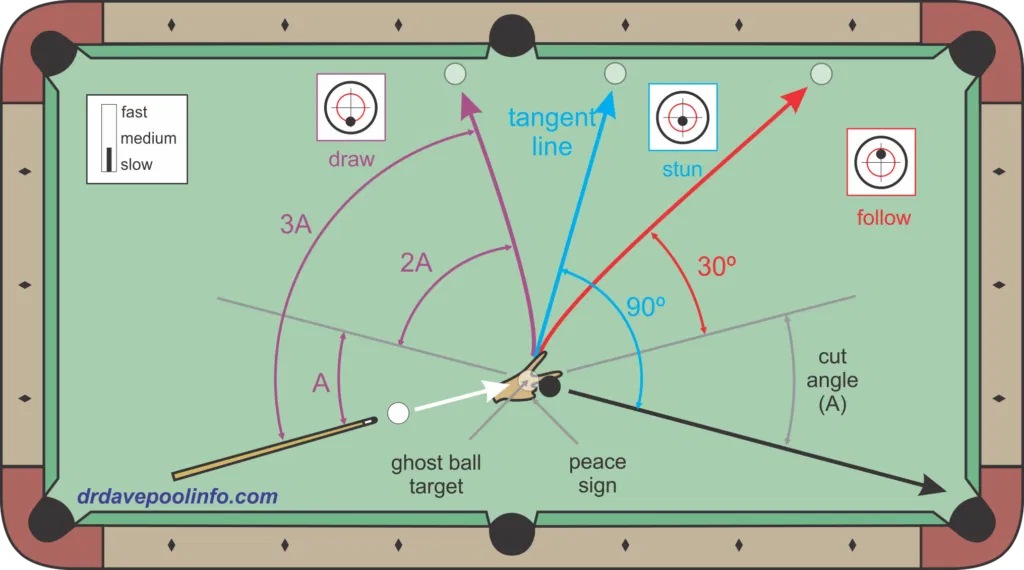
Dr. Dave Alciatore explains that a stun shot sends the cue ball along the tangent line, perpendicular to the line connecting the ball centers at impact. The essential condition is no topspin or backspin at collision. A straight-in stun is the exception: the cue ball stops rather than traveling sideways.
The reference is the collision geometry, not simply a right angle to your cue. The rule predicts direction, not finishing distance. It is a practical baseline; friction, ball elasticity, and spin can introduce departures from the ideal model.
Cover diagram: Dr. Dave Pool Info, showing reference directions for stun, follow, and draw.
How can you practice making a prediction?
Try this original 15-shot observation routine. It is an editorial exercise, not a Billiard University examination or an official rating test.
Choose a comfortable cut into a corner pocket. Keep the object ball and cue ball positions consistent for five attempts. Before each shot, point to the cushion area you expect the cue ball to approach. After shooting, write down three things: whether you pocketed the ball, where the cue ball actually went, and whether you stayed with the intended delivery.
Repeat from a second comfortable angle, then a third, for five attempts each. Use a phone photograph to help recreate each setup between attempts. Do not change several things at once after a miss; a repeatable setup makes the comparison useful.
Score your observation separately from pocketing. A made ball with an unexplained cue-ball route is useful feedback, but it should not receive the same practice note as a shot that matched your plan.
What should you review afterward?
Pick one setup where the prediction and result differed most. Save that photograph and your notes for the next session. If you work with an instructor, those details provide a concrete starting point for discussing the shot.
For the broader vocabulary, see our guide to stop, stun, follow, and draw.
Does hitting center ball guarantee a stun shot?
No. What matters is the cue ball's rotation when it reaches the object ball, not tip position alone.
Is this the same as the 30-degree rule?
No. The 90-degree reference concerns stun; the familiar 30-degree guideline concerns a naturally rolling cue ball on suitable cut shots.
Source: Dr. Dave Pool Info: 90° Rule. Diagram credit: Dr. Dave Alciatore.