Three Fouls, Rack Lost: The Warning Rule 9-Ball Players Miss
Three fouls can end the rack—but a missed warning can stop the penalty from being enforced.
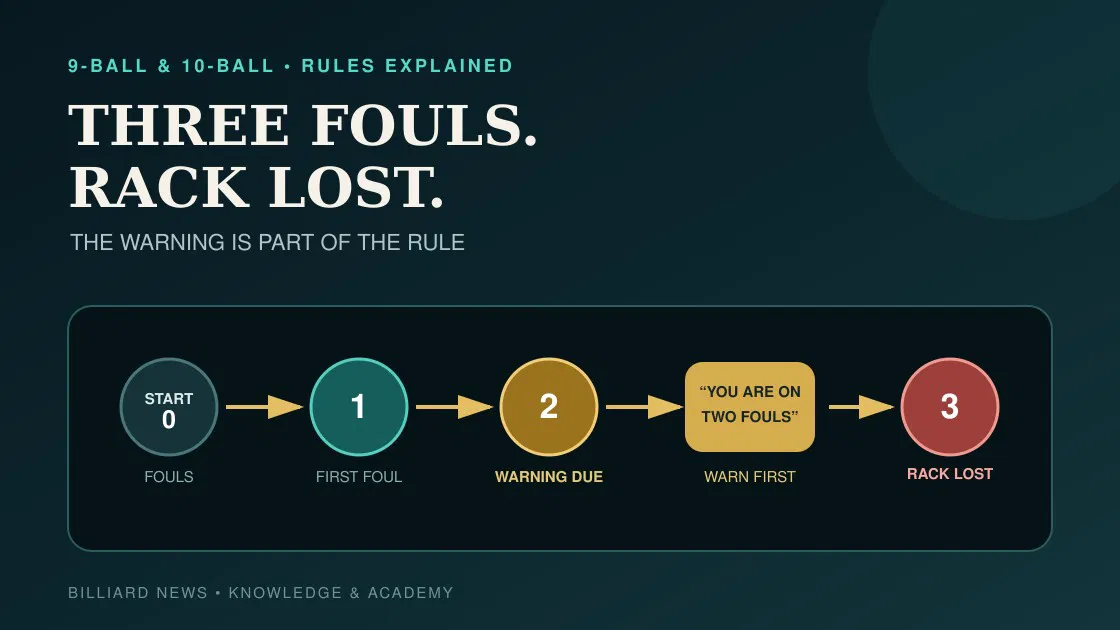
Three consecutive fouls cost the current rack in WPA 9-ball and 10-ball—but only when the same player commits all three without making a legal shot in between, within the same rack, and receives the required two-foul warning before the possible third foul.
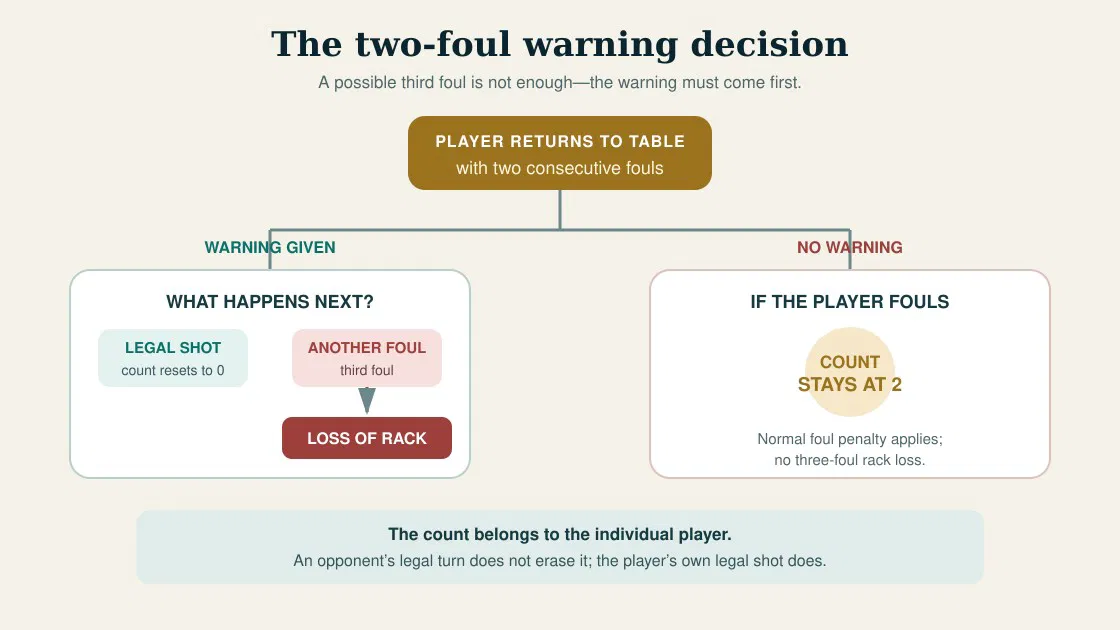
That warning is not a courtesy. It is part of the rule. If the player is not warned when returning to the table on two fouls, the next foul is treated as only the second for three-foul purposes.
When do three fouls cause a loss of rack?
WPA Rule 3.13 defines three consecutive fouls as three fouls by one player without an intervening legal shot. In games scored by the rack, such as 9-ball, all three must occur in the same rack. WPA’s 9-ball and 10-ball sections then set the penalty: loss of the current rack.
Four conditions therefore have to be present:
- The fouls belong to the same player.
- That player has not made a legal shot between them.
- The fouls occurred in the same rack.
- The player was warned when returning to the table on two fouls.
The rule is not universal across every pool discipline. WPA specifically notes that some games, including 8-ball, do not use it.
What exactly must the two-foul warning accomplish?
The referee must warn a player who is on two fouls when that player comes to the table. The practical message is simple: “You are on two fouls.”
If the warning is not given, a possible third foul counts as only the second under WPA Rule 3.13. CSI is even more specific for BCAPL and USAPL play: the opponent or referee must issue the warning before the shot, and the player must acknowledge it.
In a self-officiated match, give the warning before the player addresses the cue ball. If the foul count is disputed, stop and call the tournament director before the next stroke.
Does an opponent’s legal shot reset my count?
No. The count belongs to each player individually. If Player A is on two fouls and Player B runs several balls before playing safe, Player A still returns on two fouls.
The count resets only when Player A completes a legal shot or when the rack ends. A safety can reset the count even if no ball is pocketed, provided the shot satisfies every applicable requirement.
Does pocketing a ball automatically make the shot legal?
No. A pocketed ball does not erase a foul if the shot is illegal overall. Examples include:
- Contacting the wrong object ball first.
- Scratching the cue ball.
- Failing to satisfy the rail requirement after legal contact when no ball is legally pocketed.
- Shooting while balls are still moving.
- Committing a double hit or push shot.
If the player was properly warned on two fouls, a shot that pockets a ball and scratches can still be the third foul and loss of rack.
How do WPA and CSI rules compare?
| Rule point | WPA 9-ball / 10-ball | CSI, BCAPL / USAPL 9-ball / 10-ball |
|---|---|---|
| Third consecutive foul | Loss of current rack | Loss of current game |
| Must occur in one rack/game | Yes | Yes |
| Player’s legal shot resets count | Yes | Yes |
| Warning required on two fouls | Yes | Yes |
| Who gives warning | Referee in the written WPA rule | Opponent or referee |
| Acknowledgment required | Not specified in Rule 3.13 | Yes |
| No warning before next foul | Possible third is treated as second | Normal foul penalty; count remains at two |
| Applies to 8-ball | No | CSI Rule 1-22 does not list 8-ball |
The language differs, but the operational lesson is the same: a third foul cannot be converted into a rack-loss penalty unless the two-foul warning was properly handled first.
What are four common match situations?
Two fouls, warning given, then a scratch
The player returns on two fouls, receives the warning and scratches on the next shot. In WPA 9-ball or 10-ball, that is the third consecutive foul and the player loses the rack.
Two fouls, but no warning
The player returns on two fouls and fouls again without receiving the warning. The normal foul penalty applies, but the player cannot be charged with the three-foul rack loss. The count remains at two.
Two fouls, then a legal safety
The player contacts the correct ball first and satisfies the rail requirement, but pockets nothing. That is still a legal shot, so the foul count returns to zero.
Two fouls, then a made ball and a scratch
The player pockets the correct object ball but also scratches. The shot remains a foul. If the warning was valid, the player loses the rack.
Which mistakes cause the most disputes?
- Combining fouls from two different racks.
- Assuming the opponent’s good play resets the player’s count.
- Giving the warning only after the third foul happens.
- Warning while the player is already down on the shot.
- Treating every pocketed ball as proof of a legal shot.
- Applying WPA procedure automatically to an APA match or a local event with modified rules.
- Failing to record the foul sequence in a match without a table referee.
League and tournament rules can modify standard procedures. The event player guide controls when it differs from the general rulebook.
How should a local tournament track the rule?
Use a simple sequence beside each player’s name:
0 → 1 → 2 → warning → 3 / rack lost
Reset the count to zero after that player makes a legal shot or after the rack ends. A referee or scorekeeper should record the warning, not merely the fouls, because the warning is the step that makes the third-foul penalty enforceable.
Do three fouls carry over to the next rack?
No. In WPA 9-ball and 10-ball, the three fouls must occur in the same rack.
Can a legal safety reset the foul count?
Yes. A legal shot resets the player’s count even if no ball is pocketed.
What happens if the two-foul warning is missed?
The next foul cannot be used as the third-foul rack-loss penalty. Under WPA it is treated as the second; CSI keeps the count at two after the normal penalty.
Does the rule apply to WPA 8-ball?
No. WPA Rule 3.13 identifies 8-ball as a game that does not include the three-consecutive-fouls rule.